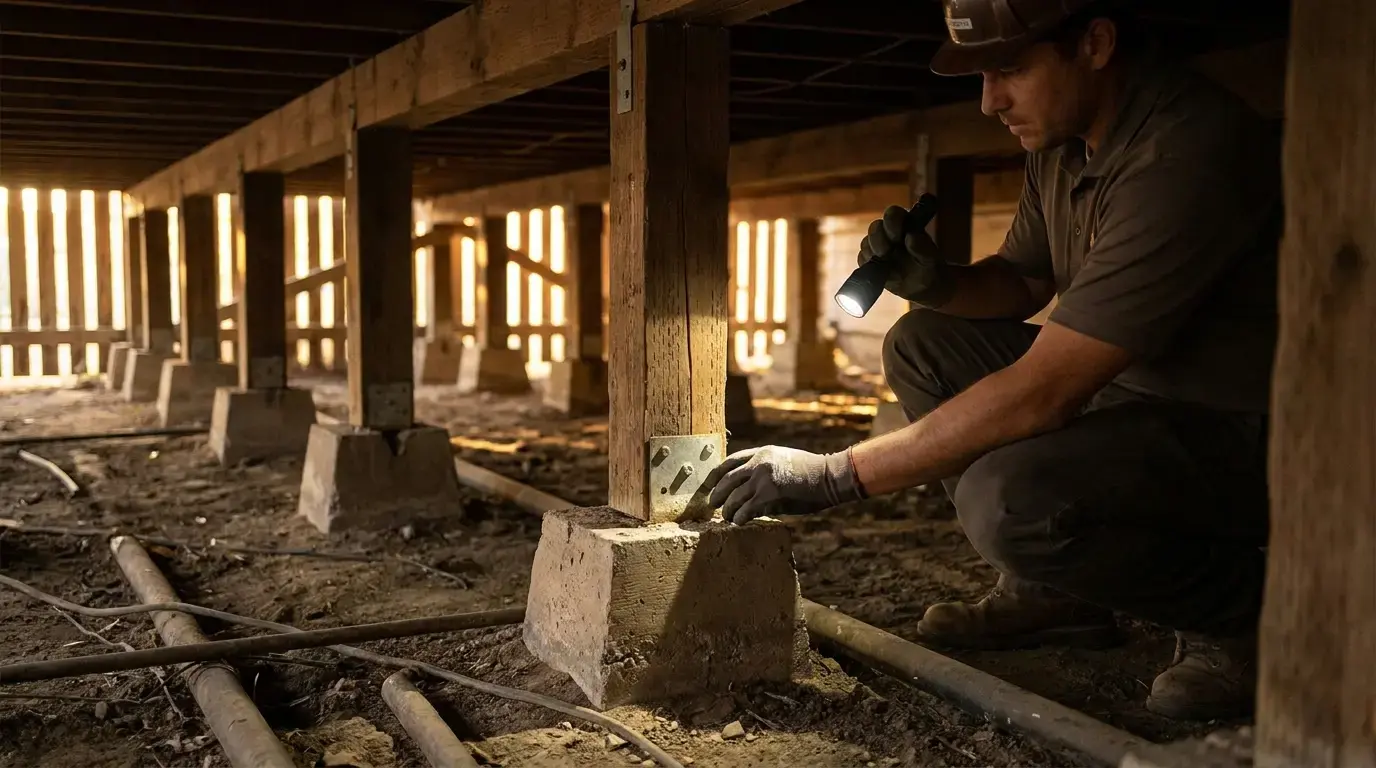
If you own an older San Diego home with a crawl space, you almost certainly have a post-and-pier foundation. Most pre-1950 homes in San Diego use this system. When it works, it’s surprisingly resilient. When it fails, you get sloping floors, sticking doors, and a repair bill that climbs the longer you wait.
Here’s what you need to know about how these foundations fail, what fixes them, and what it costs.
What a post-and-pier foundation is
A post-and-pier foundation lifts the home off the ground on a grid of concrete piers with wood posts sitting on top. The posts carry the floor beams, which carry everything above. There’s no continuous perimeter of concrete the way a slab or full stem wall foundation works, just individual point supports spaced across the crawl space.
This design was standard practice in San Diego for craftsman bungalows, Spanish revivals, and most other residential construction through the mid-20th century. You’ll find it throughout North Park, South Park, City Heights, Golden Hill, and older pockets of Hillcrest, National City, and Chula Vista.
The system has real advantages. It keeps the structure up off the ground, gives access to plumbing and wiring under the house, and allows for some natural movement. But it has one weakness that catches up with almost every old home eventually: wood.
How post-and-pier foundations fail
Rot and moisture damage are the most common culprits. San Diego’s mild climate feels dry, but crawl spaces trap ground moisture, especially in homes near canyons, older neighborhoods with poor drainage, or anywhere downhill from a neighbor’s irrigation. Wood posts sitting on concrete piers absorb that moisture over decades. They soften, compress, and eventually sink or shift.
Beyond rot, a few other failure patterns show up regularly:
Undersized or crumbling piers. Early concrete mixes weren’t always reliable. Some piers have deteriorated to the point where they crumble under load. Others were poured too small to begin with.
Soil settlement. The ground under individual piers can shift, especially in areas with expansive clay soils or old fill. When a pier loses its footing in the soil, the post above it drops.
Missing connections. Older homes often have posts that simply sit on piers with no hardware anchoring them. Seismic events, even minor ones, can shift them off-center. Post-1994 code changes require positive connections, but millions of square feet of older housing never got retrofitted.
Deferred maintenance. A small lean in one post, caught early, is a shimming job. Left for years, it loads adjacent posts unevenly and the problem spreads.
The warning signs
Most homeowners notice the symptoms before they ever look under the house. The signs of foundation problems in a post-and-pier home usually start with floors.
- Floors that feel spongy or bouncy in certain spots
- A noticeable slope, you can feel it when you walk, or a marble will roll consistently in one direction
- Doors that stick or won’t latch, especially interior doors on the first floor
- Gaps between the baseboard and the floor, or between the floor and the wall
- Squeaking that gets worse over time, not better
Any one of these alone might have an innocent explanation. Two or more together, in a home with a crawl space, usually points back to the foundation.
Sticking doors and windows are particularly reliable indicators, they show up when the frame of the house is racking out of square, which happens when support is uneven.
Repair options
Foundation repair for a post-and-pier system depends on how far the problem has progressed.
Re-leveling. If the posts and piers are structurally sound but the house has settled unevenly, re-leveling is the right call. A crew crawls under the house, jacks up the low section, and installs steel shims or replaces the post to hold the corrected height. Done correctly, this can restore a floor from a half-inch slope to nearly flat. Done badly, with wood shims that will compress or rot, it’s a temporary fix that fails within a few years.
Post and pier replacement. When individual posts have rotted or piers have crumbled, replacement is the only real fix. New concrete piers are poured or pre-cast piers are installed, and new pressure-treated posts or adjustable steel columns replace the wood. This is more invasive work but it addresses the actual failure.
Adding piers. Sometimes the original system was under-built for the load, or an addition was put on without adequate support. Adding new piers in the right locations can redistribute the load and stop the settling.
Supplementing with helical piers. For areas where soil conditions are poor or the home needs deeper support than surface-level piers can provide, helical piers can be driven into stable soil below. This is less common for post-and-pier repairs than for slab foundations, but it’s sometimes the right call when the soil itself is the problem.
House leveling, whether through shimming, replacement, or adding support, is the core of what post-and-pier repair looks like in practice. It’s not a simple job, and it requires someone who can read what’s actually happening under the house, not just level one spot while creating a new problem somewhere else.
Fix the moisture problem too
This is where a lot of repairs fall short. You can replace every post and pier in the crawl space, but if the moisture problem that rotted the original posts is still there, you’re on a clock to the next failure.
Crawl space repair, vapor barriers, drainage correction, ventilation, needs to be part of the conversation. A vapor barrier alone won’t fix poor drainage, and fixing drainage won’t do much if the crawl space has no barrier between the soil and the wood above it.
Read more about what crawl space work involves and why it matters in our crawl space repair guide.
Cost ranges
| Repair type | Typical range |
|---|---|
| Re-leveling (shimming, minor) | $1,500 – $4,000 |
| Post and pier replacement (partial) | $3,000 – $8,000 |
| Full post and pier replacement | $8,000 – $20,000+ |
| Adding new piers | $1,500 – $5,000 |
| Crawl space moisture work | $1,500 – $6,000 |
These are general ranges. The actual cost depends on how many posts need attention, the crawl space access, the soil conditions, and whether drainage work is included. A home with eight compromised posts and a wet crawl space costs more than one with two shifted posts and a dry crawl space.
See our house leveling cost guide for a deeper breakdown of what drives pricing.
When re-leveling is enough vs. when you need more
Re-leveling makes sense when the posts and piers themselves are still sound, you’re correcting settlement, not replacing failed components. If an inspection shows solid concrete, intact wood, and no active rot, shimming and adjusting is often all you need.
You need more when there’s active rot, crumbling concrete, or a soil problem that surface-level piers can’t address. Trying to re-level a post that’s actively rotting just delays the next call.
The only way to know which situation you’re in is to get under the house and look. That’s where we start every inspection.
Get a free inspection
If your floors are sloping, your doors are sticking, or you know you have an older home with a crawl space and you’ve never had it looked at, a free inspection is the right first step. We’ll get under the house, tell you what we see, and give you a straight answer about what it needs.
Call Base Pro San Diego at (858) 925-5546 to schedule. No sales pressure, just an honest look at what’s there.