Push pier underpinning in San Diego. Driven to refusal. Verified by load.
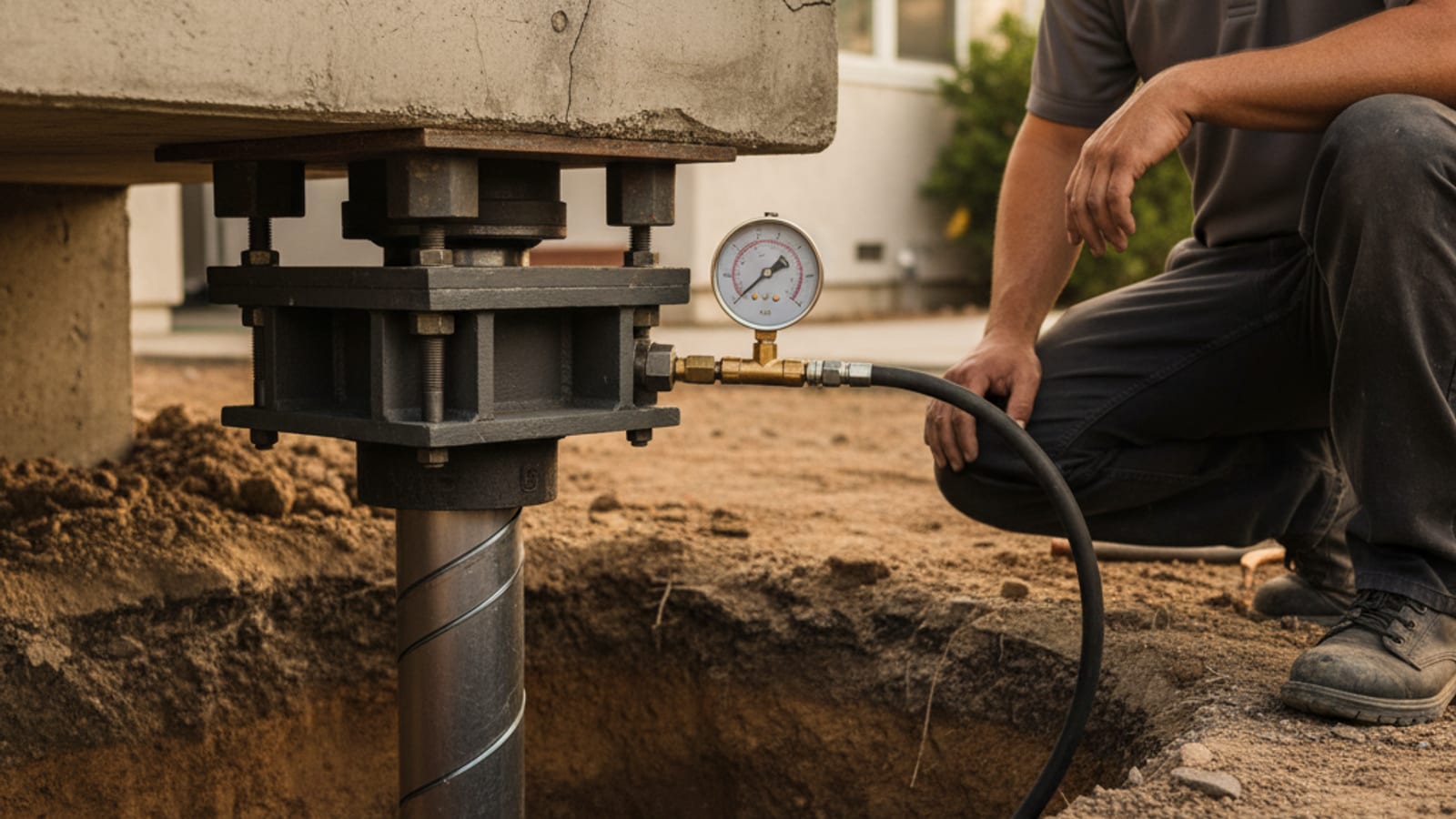
Push piers (also called resistance piers) use the weight of the building as the reaction force to drive a steel shaft section by section into the ground. They keep going until the soil pushes back hard enough to verify the pier can carry the engineered design load. Right tool for two-story homes, masonry construction, and deep settlement on heavy structures.
What's included in this service?
- Excavation at each pier location to expose the footing
- Foundation bracket installation cast or bolted to the footing
- Section-by-section hydraulic driving with pressure gauge readings
- Drive to engineered refusal pressure (typically 2x design load)
- Final lock-off with locking plates and nuts
- Optional structural lift at each pier with synchronized hydraulics
- Backfill, compact, and restore landscape
- Engineer field observation and stamped pier log
When do you need this service?
- Two-story home or masonry construction with active settlement
- Soil reports show competent strata is over 25 feet deep
- Helical torque cannot reach design capacity in the soil profile
- Repair of an older driven concrete pier system that has failed
- Commercial or multi-family structure with heavy footings
What do homeowners ask about Push Piers?
Why pick push piers over helical?
When the structure is heavy enough to push the pier into competent strata. Helical relies on torque-to-capacity correlation, which gets noisy in deep mixed soils. Push piers verify load by literally pushing the pier against the soil with the building's weight. The reaction is the proof.
How is depth determined?
By refusal, not by a target. We drive each section until the hydraulic pressure on the gauge reaches the engineered refusal value, typically 2 times the per-pier design load. Some piers in San Diego County terminate at 18 feet, some go to 50+. Each pier gets a recorded log of pressure vs depth.
How disruptive is the install?
More disruptive than helicals because each pier needs an exterior excavation roughly 4 ft x 4 ft x 4 ft deep. Landscape and hardscape have to come up and go back. We document the as-found condition and restore at the end. Interior occupants typically stay in the home.
Can a push pier be undone?
Removed, no. Adjusted later, yes. The locking nuts allow re-leveling within a small range without re-driving. A failed pier can also be replaced with a new pier set adjacent to it.
Where do we offer Push Piers in San Diego County?
We provide push piers in every city and community in San Diego County. Pick your city for local climate notes and service specifics.
See push piers in all 67 cities
Need push piers in San Diego County?
Call for a free quote. Most work scheduled within the week.