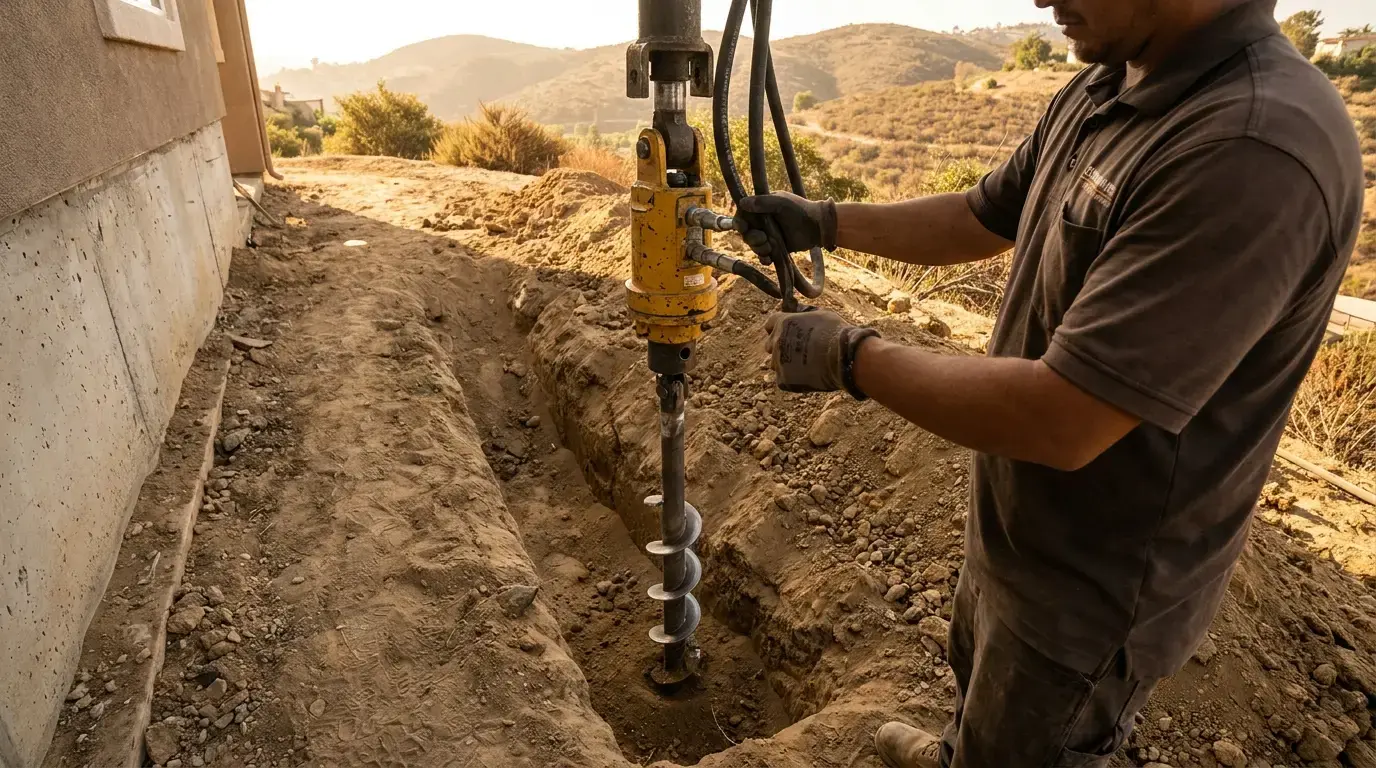
Underpinning is the process of extending or strengthening a foundation so that the load of a structure reaches deeper, more stable soil or bedrock. It’s the go-to fix when a foundation has settled, shifted, or no longer sits on soil capable of holding the weight above it. Most underpinning jobs in San Diego use steel piers driven past the weak surface soil to reach competent bearing layers.
If your house is cracking, sticking, or visibly tilting, underpinning is likely what a foundation engineer will recommend. Here’s what it means, how it works, and what to expect.
Why San Diego homes settle in the first place
Settlement happens when the soil under a foundation compresses, shifts, or erodes. San Diego has a few specific conditions that make this common.
Expansive clay soil swells when it absorbs water and shrinks when it dries out. That cycle of expansion and contraction moves foundations up and down over time. Much of inland San Diego, including areas around El Cajon, Santee, and Spring Valley, sits on this kind of soil.
Fill soil is another major factor. Many hillside lots were leveled with imported fill material that was never properly compacted. That fill compresses slowly under the weight of a house, sometimes for decades.
Slope movement is common in canyon-adjacent neighborhoods. Soil on a slope tends to creep downhill, pulling footings with it.
Water intrusion, whether from poor drainage, broken irrigation, or prolonged rain, saturates soil and reduces its load-bearing strength. When wet soil can’t support the foundation, the structure sinks.
Any of these conditions, alone or in combination, can push a foundation past the point where surface-level repairs are enough. That’s when underpinning becomes necessary.
The main underpinning methods
There are several ways to underpin a foundation. The right method depends on soil type, site access, the depth of stable bearing material, and the load being supported.
| Method | How it works | Best for |
|---|---|---|
| Helical piers | Steel shafts with helical plates screwed into the ground like a bolt | Lighter loads, limited access, variable soil depth |
| Push (resistance) piers | Hydraulic rams drive steel pipe segments into the ground using the house’s own weight | Heavier loads, confirmed bearing layer at depth |
| Mass pour / concrete underpinning | Sections excavated by hand, filled with concrete in stages | Shallow repairs, older structures, tight budgets |
| Grout injection | Expanding grout pumped into voids beneath the slab | Slab lifting, void fill, not structural deepening |
Helical piers are the most versatile option. They can be installed in tight crawl spaces, near trees, and in areas with limited equipment access. The helical plates anchor into soil based on torque readings taken during installation, which gives engineers a real-time measure of load capacity.
Push piers are driven deeper using hydraulic pressure and rely on skin friction and end-bearing to resist movement. They’re well-suited to heavier structures where the load itself helps confirm bearing. You can compare these two approaches in detail in our post on helical vs. push piers.
Mass pour underpinning is an older technique still used in some situations. Workers excavate under the footing in alternating sections, pour concrete, let it cure, then move to the next section. It’s labor-intensive and limited to shallow depths, but it can work where access rules out mechanical piers.
Grout injection is sometimes called mudjacking or polyurethane lifting when applied to slabs. It fills voids and raises settled concrete but doesn’t extend the foundation to deeper soil. It’s appropriate for cosmetic slab settlement, not structural repair.
How the underpinning process works, step by step
A typical pier installation follows a predictable sequence.
First, a structural engineer or experienced contractor inspects the home, reviews the settlement pattern, and determines where piers are needed and what type. They’ll look at crack locations, floor slope measurements, and sometimes conduct a soil report.
Next, the crew excavates small holes or pits at each pier location, typically alongside the footing. These pits are usually 2 to 3 feet wide and deep enough to expose the bottom of the footing.
Steel pier brackets are bolted or welded to the underside of the footing. These brackets are the connection point between the house and the pier below.
The pier itself is then installed. For helical piers, a hydraulic torque motor screws the lead section into the ground, adding extension sections as needed until the target torque is reached. For push piers, hydraulic rams drive pipe segments until they hit refusal at the bearing layer.
Once all piers are in place, the crew uses the system to lift the foundation back toward its original position. This is called controlled lift or hydraulic jacking. Not every structure can be fully returned to original elevation, so engineers set realistic lift targets based on what the structure can tolerate.
Finally, the brackets are locked off, the pits are backfilled, and the crew assesses any cracks or finishes that need attention.
The whole process for a partial repair can take one to three days. A full perimeter job on a larger home may run a week.
Signs your home may need underpinning
Not every crack means a foundation problem, but some patterns are worth taking seriously. These are the ones that point toward settlement requiring underpinning.
Diagonal cracks running from the corners of doors and windows, especially when they’re wider at one end, indicate differential settlement. The foundation is dropping in one area faster than another.
Floors that slope measurably from one room to another are a consistent sign. A two-inch drop across 20 feet is notable. Four inches across the same span is urgent.
Doors and windows that stick, won’t close fully, or have visible gaps at the frame corners suggest the structure is racking, meaning it’s being pulled out of square by foundation movement.
Exterior cracks in stucco or brick that follow a stair-step pattern along mortar joints signal movement in the wall below.
If you’re seeing more than one of these signs together, it’s worth getting a professional look. Our post on signs of foundation problems covers each warning sign in more detail.
What underpinning costs in San Diego
Costs vary based on the number of piers, soil conditions, access, and the method used. These are general market ranges for San Diego County.
Individual piers run roughly $1,800 to $3,500 installed, depending on depth and type. Helical piers tend to cost more per unit than push piers in straightforward conditions, but they’re often the only option in constrained sites.
A partial repair addressing one corner or one side of a home typically runs $8,000 to $18,000.
A full perimeter repair on a standard single-story home generally falls in the $25,000 to $50,000 range. Larger homes, two-story structures, or sites with difficult access will run higher.
For more detail on what drives pier pricing locally, see our breakdown of helical pier costs in San Diego.
Is underpinning permanent?
Done correctly, yes. Steel piers driven to bedrock or dense bearing soil don’t compress, degrade, or shift under normal conditions. The pier material is galvanized or epoxy-coated for corrosion resistance, and the bracket-to-footing connection is engineered to transfer load permanently.
The question isn’t usually whether the piers will hold. It’s whether the rest of the foundation, the slab, the footings, the stem walls, has enough integrity to work with the piers. A good inspection answers that before any work starts.
Most reputable contractors also warranty their pier systems for the life of the structure, which tells you something about confidence in the method.
Getting a clear answer starts with an inspection
If you’re seeing cracks, slopes, or sticking doors and you’re not sure whether your home needs underpinning or a lighter fix, the starting point is a free onsite inspection. We look at the full picture: settlement pattern, soil context, structural load, and access. Then we tell you what we’d actually recommend, without pressure.
Foundation repair and house leveling sometimes work alongside underpinning, and sometimes one approach is all that’s needed. You’ll know exactly where things stand before you make any decisions.
Call Base Pro San Diego at (858) 925-5546 or schedule your free inspection online. We serve all of San Diego County, from Chula Vista to Escondido.