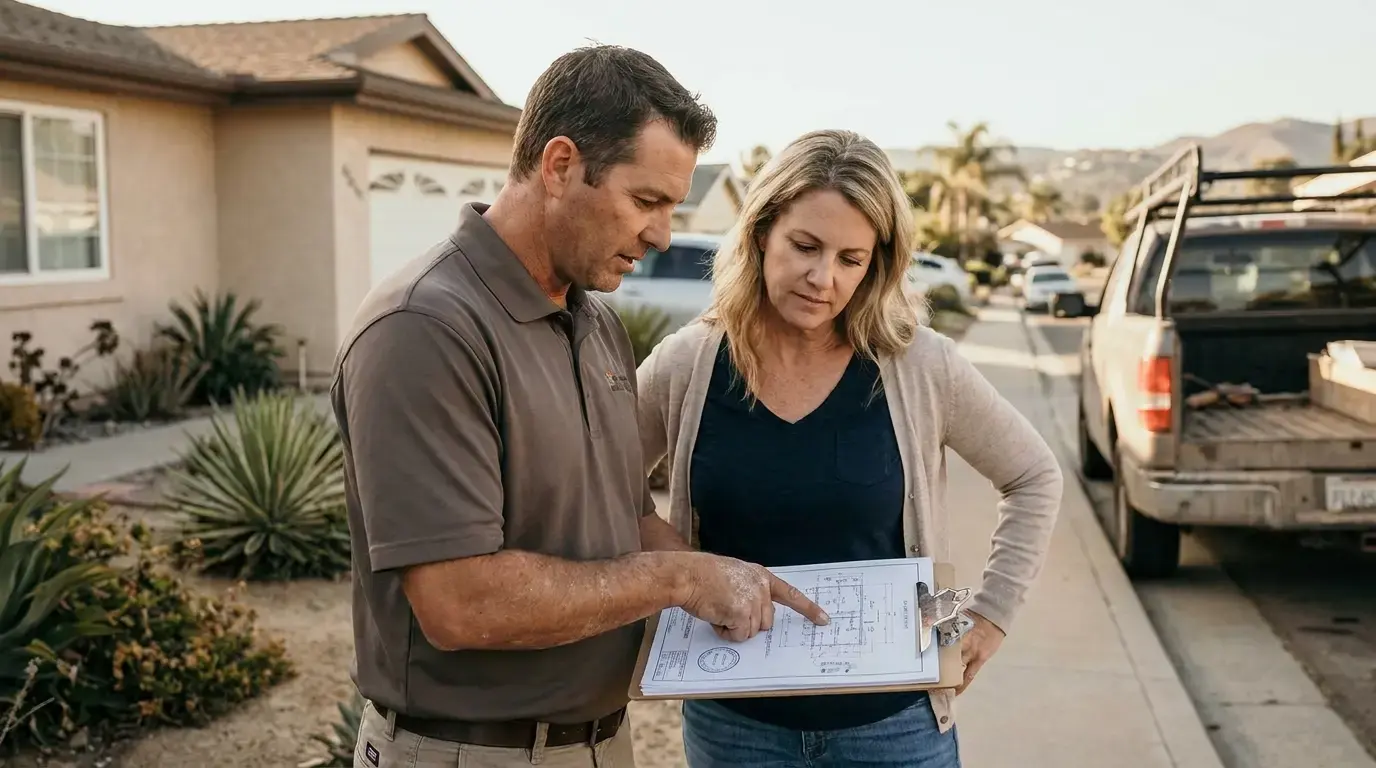
The most important thing you can do before signing a foundation repair contract is verify the contractor’s CSLB license and make sure a structural engineer is part of the process. Most bad outcomes in foundation repair trace back to two problems: an unlicensed or wrong-license contractor, and a repair plan built on a sales pitch rather than engineering. Get those two things right and the rest becomes manageable.
Here’s how to work through every step, from the first phone call to the permit sign-off.
Check the CSLB license first
California’s Contractors State License Board (CSLB) licenses every legitimate contractor in the state. You can look up any contractor at cslb.ca.gov in about 30 seconds.
For foundation repair, you want either a Class A (General Engineering) license or a C-61 specialty license in the right subcategory. A B (General Building) license is not the right credential for foundation work. Some contractors carry both A and B, which is fine. What matters is that they have the engineering classification.
While you’re on the CSLB site, confirm:
- The license is active, not suspended or expired
- The bond and workers’ comp are current
- No disciplinary actions on record
A license check takes two minutes. Skip it and you have no protection if something goes wrong.
Insist on engineering, not just a sales estimate
This is where many homeowners get into trouble. A salesperson walks the property, taps a few walls, and quotes you 12 piers. That is not a diagnosis.
A real foundation inspection includes a floor level survey (measuring actual differential settlement across the slab or crawlspace), crack mapping, and a review of soil conditions. In San Diego, you’re often dealing with expansive clay in North County, sandy soils near the coast, or hillside fill that behaves differently from native soil. The repair plan should reflect your specific situation.
Ask every bidder: who is the engineer on this project? You want a licensed structural engineer producing a stamped plan. That plan tells the city what’s being done, it tells the crew exactly where to place piers, and it gives you a document you can hand to a future buyer.
Some contractors have an in-house engineer. Others use an independent firm. Either can work. What doesn’t work is a contract with no engineering at all.
Get at least three bids
Foundation repair bids vary significantly. One company might quote 8 piers, another quotes 14 for the same house. The difference often comes down to the underlying diagnosis.
Getting three bids does two things. It gives you a real price range so you’re not flying blind. And it tells you whether contractors are diagnosing the same problem the same way. If two out of three say 10 piers and the third says 20, that’s worth asking about.
For context on what you might see in San Diego, our foundation repair cost guide breaks down typical ranges for helical piers, push piers, and slab work.
Don’t just pick the lowest bid. Pick the contractor whose diagnosis makes the most sense and who can back it up with engineering.
Understand what you’re being sold
Helical piers and push piers are the two most common deep foundation solutions. They work differently and suit different conditions. If a contractor recommends one without explaining why it fits your soil type and load conditions, ask them to explain it. A good contractor will walk you through the reasoning. Our post on helical vs push piers covers the differences if you want to go in prepared.
Mudjacking, foam lifting, and carbon fiber crack repairs are also legitimate tools, but they address different problems. Make sure the method matches the actual cause of your settlement.
Ask about warranties, and read the terms
A solid foundation repair warranty covers two things: the manufacturer’s coverage on the materials (typically 25 years or lifetime on pier systems from companies like CHANCE or Ram Jack), and the contractor’s workmanship warranty on the installation.
Ask each bidder:
- How long is your workmanship warranty?
- Is it transferable to a future buyer?
- What does it exclude?
A warranty that excludes “continued soil movement” in San Diego is almost meaningless. Make sure you understand what’s actually covered before you sign.
Require a permit
Foundation repair almost always requires a permit in San Diego County. The permit triggers an inspection by a city or county building official, which is a check on the contractor’s work. If a contractor tells you permits aren’t necessary, or suggests skipping them to save money, walk away.
Unpermitted foundation work creates problems when you sell. Lenders and buyers will ask for documentation, and “we did it without a permit” is not a good answer.
Read the reviews, but read them carefully
Online reviews tell you something, but not everything. Look for patterns across multiple reviews. A handful of angry reviews mixed into 80 positive ones is different from consistent complaints about the same issue.
Pay attention to reviews that mention what happened after the job. Did the contractor show up when there was a warranty question? Did the settlement hold? That’s more useful than a review about the crew being polite.
Also check the Better Business Bureau and the CSLB complaint database, not just Google and Yelp.
Questions to ask every bidder
Use this as a starting checklist when you’re comparing contractors:
| Question | What a good answer looks like |
|---|---|
| What’s your CSLB license number and class? | Active A or C-61 license, verifiable at cslb.ca.gov |
| Who is the engineer on this job? | Named licensed structural engineer, stamped plan included |
| What did your level survey show? | Specific differential measurements, not vague “settling” |
| Why this pier type for my soil? | Clear reasoning tied to soil conditions and load |
| How many piers, and where? | Specific count with a layout drawing |
| Will you pull a permit? | Yes, always |
| What does your warranty cover, exactly? | Written terms, transferable, clear exclusions |
| Can I see references from similar jobs? | Recent San Diego projects, verifiable |
Red flags that should make you walk away
Some contractor behaviors are warning signs of a hard sell rather than an honest fix. Watch for:
Pressure to sign today. A real foundation problem has been developing for years. It won’t collapse overnight. Any contractor pushing a same-day decision is selling urgency, not repair.
No engineering. If the bid doesn’t include a structural engineer and a stamped plan, you’re buying guesswork.
Vague pier counts. “We’ll probably use around 10 to 15 piers” is not a plan. You should get a specific count and a layout drawing.
“We always use X.” Good contractors match the solution to the problem. If a contractor leads with their preferred product before they’ve done any diagnosis, that’s backward.
No permit. Already covered above. Non-negotiable.
For more on what to look for before you even call a contractor, the foundation inspection checklist and our guide to signs of foundation problems are good starting points.
One more thing: trust your read on the person
Licenses and engineering matter most. But foundation repair is also a relationship. The work involves access to your home, coordination with the city, and a multi-year warranty. The contractor should be clear, patient with questions, and willing to explain their reasoning. If they get impatient when you ask about the engineering plan, that tells you something.
If you’re ready for an honest look at your foundation, we offer a free onsite inspection. We’ll do a level survey, walk the property with you, and give you a straight answer about what’s going on and whether repair is actually needed. No pressure, no sales pitch.
Call us at (858) 925-5546 or request your inspection through our foundation inspection page.