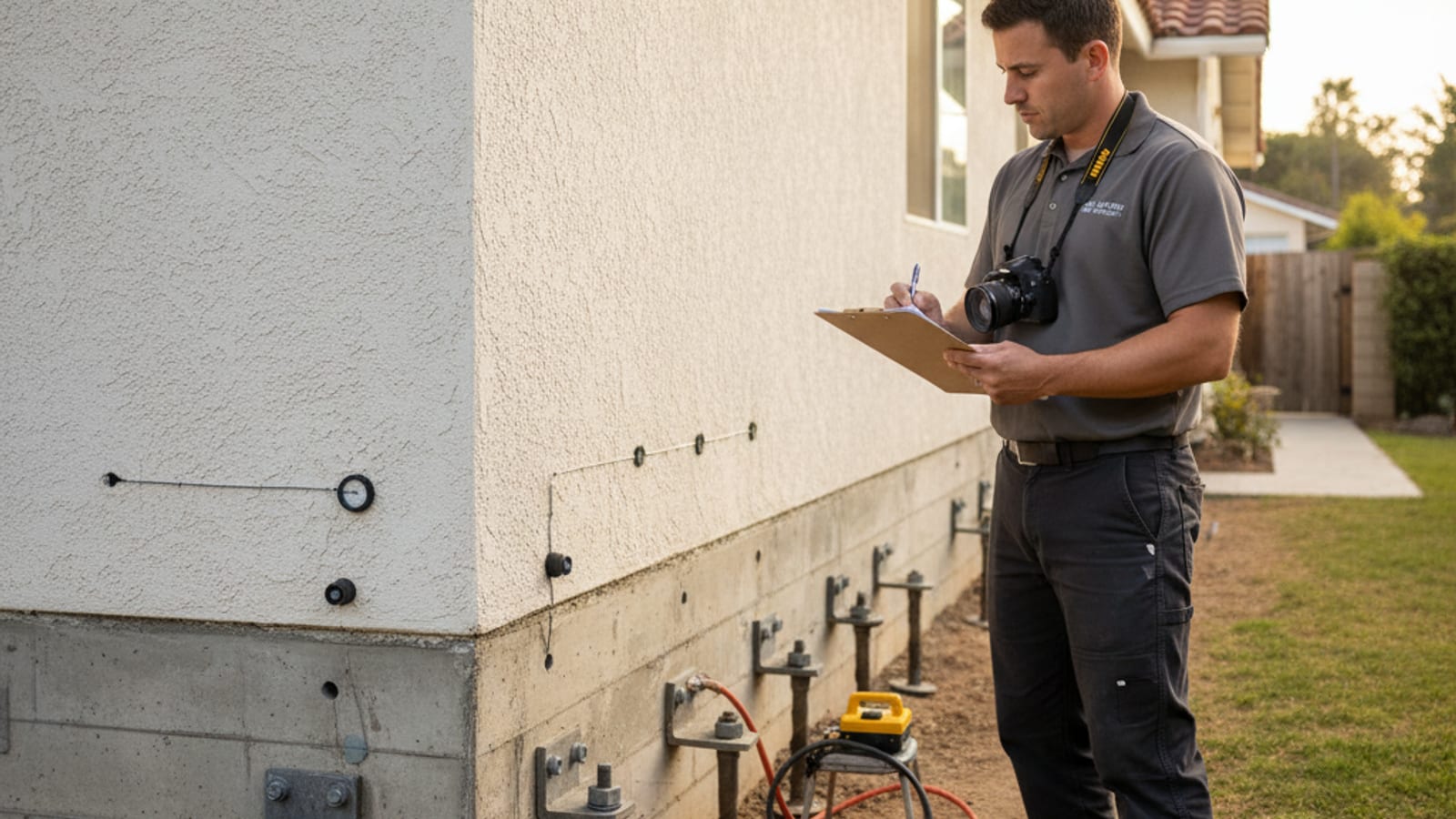
Buying a home in San Diego County means making a $700K-plus decision with limited information. The general home inspection touches 100 systems for 30 seconds each. Your foundation deserves more attention than that. It’s the most expensive thing on the property to fix if something is wrong.
Here’s the 25-point foundation inspection checklist we run, in the order we run it. You can use this as a self-walk-through before scheduling a paid inspection, or as a checklist to bring to your home inspector.
Exterior, ground level
1. Walk the perimeter and look at the slab-stem-wall joint. Tight, uniform = good. Visible gap, especially with daylight or efflorescence = note it.
2. Look for stair-step cracks in stucco, brick, or block walls, especially low on the walls near the foundation.
3. Check the corners of every window and door. Diagonal cracks at corners are structural-suspect. Photo-document each one with a coin or ruler for scale.
4. Look for vertical cracks in the foundation itself (the visible stem wall above grade). Width over 1/16 inch (credit card edge) is “call us.” Width with vertical offset (one side higher) is “call us regardless of width.”
5. Walk the grade. First 10 ft from the house should slope away, a minimum 6 inches drop in 10 ft. Flat or reverse-slope grade = water pooling at the foundation.
6. Check downspouts. Each one should discharge at least 5 ft from the foundation, ideally tight-lined to a drain or a remote daylight. Downspouts dumping water at the footing = future problem.
7. Look at hardscape (driveway, patio, walkways) within 10 ft of the house. Settled, cracked, or hollow-sounding hardscape often correlates with soil voids next to the foundation.
8. Check retaining walls. Lean, bulging, drainage failure (efflorescence, weep-hole blockage), or cracks running through the wall.
Exterior, eye level and above
9. Roof line, visible dip or sag? A roof ridge that has a visible dip is sometimes interior framing, sometimes foundation settlement transmitted up through the structure.
10. Chimney lean. Chimneys often settle independently of the house because their footing is separate. A leaning chimney is a foundation issue (the chimney’s, not the house’s, but it’ll need attention).
11. Trees within 15 ft of the foundation. Large trees pull moisture from the soil seasonally and can drive expansive-clay movement. Eucalyptus, pepper trees, and pines are the worst offenders.
12. Drainage swales. If the lot has a swale designed to carry water around the house, it should be clear and graded. Filled, blocked, or graded against design = water finding the foundation instead.
Interior, main floor
13. Door test. Open and close every door in the house. Stuck, dragging, or out-of-square doors are early settlement indicators. Note pattern: are sticking doors clustered on one side?
14. Window test. Same as doors. Casement and double-hung windows that won’t operate smoothly often indicate frame is no longer square.
15. Floor slope. Roll a marble across each main living area. Note direction and severity. A noticeable slope (marble accelerates) is over 1 inch in 20 ft.
16. Baseboard gap. Walk the perimeter of each room and look for gaps between baseboard and floor (mid-wall, not at corners). 1/8 inch gap = floor has dropped from baseboard.
17. Tile and flooring cracks. Straight-line cracks in tile or buckled hardwood lines often trace foundation cracks underneath.
18. Wall cracks. Look at corners of doors and windows from inside. Diagonal cracks here usually mirror exterior diagonal cracks.
19. Ceiling cracks. Cracks at ceiling-to-wall joint, especially long and continuous along one side, can indicate roof framing settlement from foundation movement below.
Interior, crawl space (if accessible)
20. Visible posts and beams. Are posts straight and bearing on intact concrete pads? Sagged or rotted posts, broken pads, or beams that have separated from posts = repair needed.
21. Floor framing condition. Look at the underside of the subfloor. Sagged joists, water staining, mold, or active moisture all need attention.
22. Cripple wall (the short stud wall between the perimeter foundation and the floor framing). Pre-1960 homes often have cripple walls without sheathing or anchor bolts, a seismic risk and failure point.
23. Ground moisture. Standing water, persistent mud, or moldy smell = drainage problem that will affect the foundation.
24. Vapor barrier. A 6-mil poly vapor barrier on the dirt is standard. Missing, torn, or rolled-back = moisture migration into the floor system.
25. Plumbing leaks. Look for staining or active drips on plumbing under the home. Even slow leaks wash out fines under the slab over time, creating voids.
What constitutes a deal-breaker?
A foundation inspection rarely produces a single “walk away from this house” finding. More often, it produces a repair estimate that you can use to negotiate the purchase price.
True deal-breakers:
- Active settlement on a hillside lot with no remediation possible without major retaining work
- Cripple wall failure visible in the crawl space with seismic risk
- Slab post-tension cable failure that’s already affected the structure
- Multiple structural cracks with consistent vertical offset across the entire foundation
Negotiation items (not deal-breakers, but real money):
- Stable old settlement that has cosmetically damaged finishes
- Drainage retrofit needed to stabilize ongoing moisture issues
- Helical pier underpinning for one or two settled corners
- Crawl space rebuild or seismic retrofit
- Crack injection for stable but visible cracks
For each repair item, get a written estimate from a qualified foundation contractor before going back to the seller. Sellers respond to numbers, not to inspector concerns.
When to hire a foundation specialist vs. trust the home inspector
General home inspectors are competent at noticing problems but rarely at quantifying them. If your home inspector flags any of the following, hire a foundation specialist for a focused inspection:
- Floor slope they can see standing still
- Cracks larger than 1/16 inch
- Active water at the foundation
- Crawl space damage they recommended further evaluation on
- Any “I’d recommend a structural engineer take a look”
A foundation-specific inspection is $450-$850 in San Diego County. It’s the cheapest insurance you can buy on a $750K-plus home purchase.
What you get from us on a paid inspection
- Full level survey across the slab and floor system, recorded at 6-foot grid
- Photo-documented crack mapping with width, length, and direction
- Crawl space inspection (if accessible)
- Drainage and grading review
- Soil and vegetation assessment
- Written report with annotated photos and findings, delivered within 3 business days
- Repair estimate (if repairs are warranted) with no obligation
Buyers, sellers, lenders, and insurance carriers will all accept the report. Engineer-stamped versions available for an additional fee when needed.
Free 30-to-60 minute walk-through inspections are available too. No written report, but a verbal estimate and a clear “yes there’s an issue” or “no, the home is solid.” Useful when you’re early in the buying process and just want a gut-check.