If you’re getting bids on foundation repair, you’ve probably heard both terms. Two contractors come out, one quotes helical piers, the other quotes push piers, and the prices are different. Are they the same thing? Are they interchangeable? Is one better?
The short answer: both are legitimate underpinning systems, both are engineer-rated, both work, but they solve slightly different problems. Picking the right one depends on your soil profile and your structure load. Here’s how to think about it.
The core difference
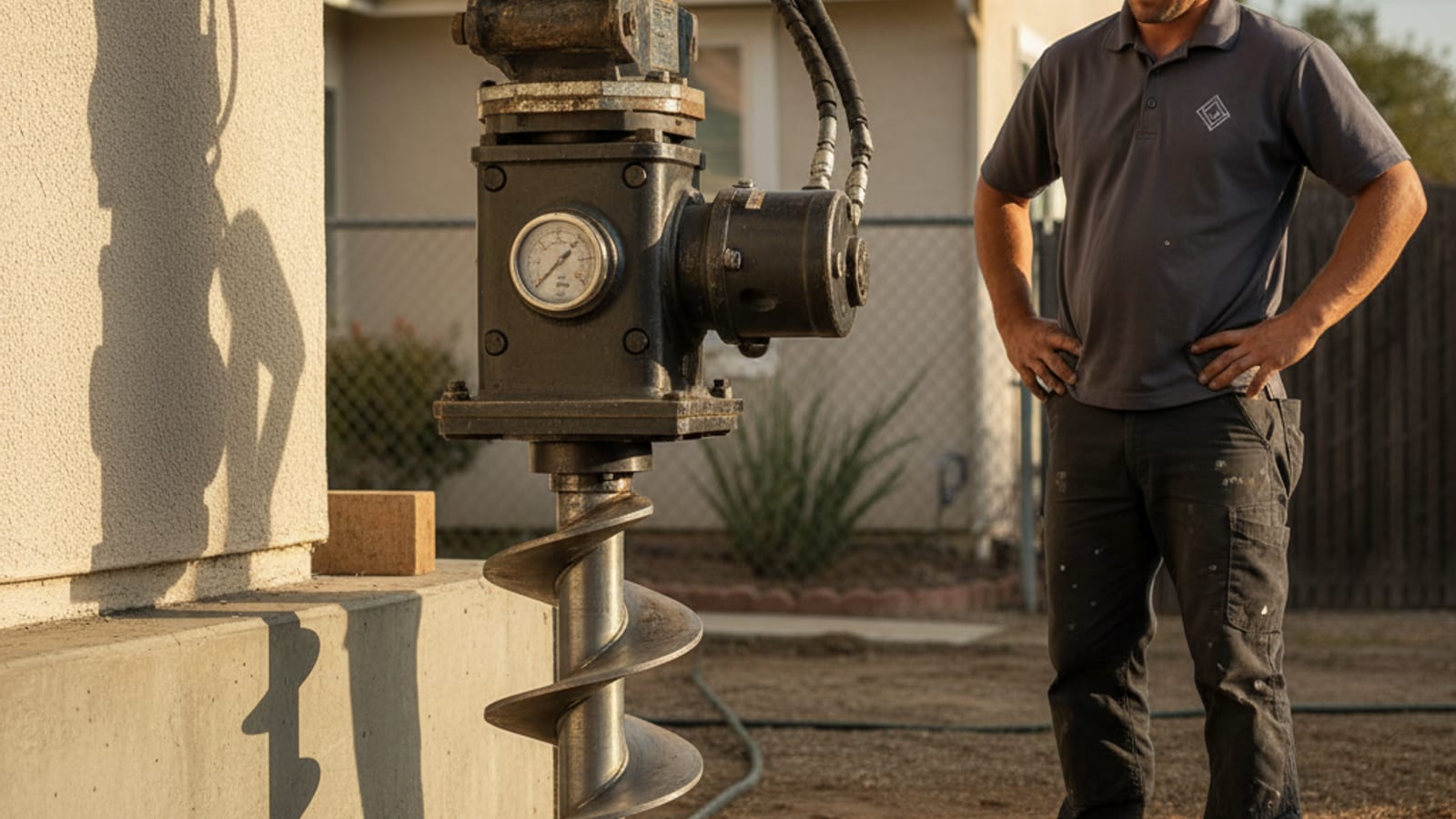
Helical piers are steel shafts with welded helical plates (think large screws). They’re rotated into the ground with a hydraulic torque head until the torque reading matches the engineered design load. The plates carry the load, like a screw biting into wood.
Push piers (also called resistance piers) are steel shaft sections driven straight down by a hydraulic ram. The reaction force comes from the weight of the building itself: the heavier the structure, the harder the ram can push. The pier is driven section by section until the hydraulic pressure on the gauge reaches engineered refusal, typically 2x the design load.
That’s the technical difference in one paragraph. The practical differences are bigger.
When helical wins
Helical piers shine when:
- The structure is light. Single-story homes, ADUs, decks, light commercial. A push pier needs the building’s weight as reaction force; a light building can’t push a pier hard enough to verify capacity.
- You need exterior-only access. Helicals can usually be installed without going inside the building, with minimal landscape disturbance. Smaller drive head, smaller staging area.
- Soil profile is mixed or unknown. Torque-to-capacity correlation is well-documented for helicals, so the load capacity is verified during install rather than relying solely on a soils report.
- You want install verification per pier, in real time. The torque head reads to the engineered torque value as the pier advances. If a pier doesn’t reach torque, you keep advancing or move to a different location. No surprise underperformers.
In San Diego County, helical piers handle roughly 70-80% of residential foundation repair. They’re the default tool for most jobs.
When push piers win
Push piers are the right answer when:
- The structure is heavy. Two-story homes, masonry, brick veneer, heavy stucco-on-block, multi-family. A helical pier may torque-out before reaching design capacity in deep soils; a push pier uses the structure’s weight to drive past that point.
- Competent strata is deep. Push piers can drive 50+ feet to refusal. Helical capacity gets noisy in mixed deep soils above about 30 feet.
- You want load-verified install. Push piers literally test the pier’s capacity by pushing it against the soil with the building’s weight. The reaction is the proof.
- Older driven concrete piers are being replaced. Push piers are the right replacement tool because the install method matches what the original system attempted to accomplish (just done correctly with steel and engineered refusal).
Push piers are about 15-20% of our residential underpinning work. More common on commercial and historic buildings.
Cost comparison
Per pier, push piers run higher. Helical: $1,800 to $3,500 installed. Push: $2,200 to $4,000 installed. That’s the part everyone sees.
The full-job comparison is murkier:
- Push piers need bigger excavations (roughly 4 ft x 4 ft x 4 ft per pier) because the bracket has to be set under the footing and the ram has to fit. More excavation = more labor + more landscape restoration.
- Helical piers can install with smaller excavations or even from outside the footing in some cases.
- Push piers sometimes drive deeper, requiring more shaft sections. Small per-section cost, but it adds up.
- Helical piers sometimes need more piers per linear foot for the same load on certain soil types.
For a typical 6-pier residential corner repair: helical packages tend to land $14,000-$22,000 total, push pier packages $18,000-$28,000. Same engineering, different equipment economics.
Warranty differences
Both systems carry lifetime-of-structure warranties from major manufacturers (CHANCE, Earth Contact Products, Magnum, Atlas, etc.) when installed by certified crews. Manufacturer warranty is shaft-to-shaft, plate-to-bracket, and load-to-bearing. Workmanship warranty (the contractor’s warranty for installation quality) varies. Ours is lifetime on labor, transferable on sale of the home.
Read both warranties before signing. The product warranty is fine print; the contractor warranty is the one that matters most when something goes wrong.
What if I’m getting different recommendations?
Two contractors recommending different pier systems is normal. Some shops are exclusively helical (Foundation Supportworks, Ram Jack helical), some are exclusively push pier (Olshan, Atlas), some do both. The recommendation often reflects what they have on the truck, not what’s best for your house.
When you’re getting bids, ask each contractor:
- Why this pier type for this house?
- What does the soils report (or local geological knowledge) suggest?
- What’s the engineer’s stamped recommendation?
- What’s the load per pier and how was it calculated?
A contractor who can answer all four with specifics is doing it right. A contractor who says “this is what we always use” is selling, not engineering.
Hybrid jobs
Some San Diego foundation repairs use both. We’ll specify push piers along the heavy two-story side of a house and helicals along the lighter single-story side. Or push piers at deep-fill corners and helicals where bedrock is shallow. The structural engineer’s plan dictates the mix; the goal is the right tool for each pier location.
A hybrid bid isn’t a sign of confusion. It’s a sign that the engineer designed the system to match the actual soil and load conditions across the building.
Practical decision flow
A simple way to think about which is likely right for your home:
- Two-story or masonry? Push piers are more likely correct.
- Single-story slab or raised foundation under 1,500 sq ft? Helicals are usually right.
- Hillside or fill lot with deep soils? The soils report decides; could go either way.
- ADU, deck, or light structure? Helicals every time.
But this is a heuristic, not engineering. The actual answer comes from the level survey, soils report (where required), and structural engineer’s plan. Don’t accept a pier-system recommendation that isn’t backed by stamped engineering.
Free inspection, free engineer consultation if your job needs one. We’ll tell you which pier system fits, and we’ll show you why.