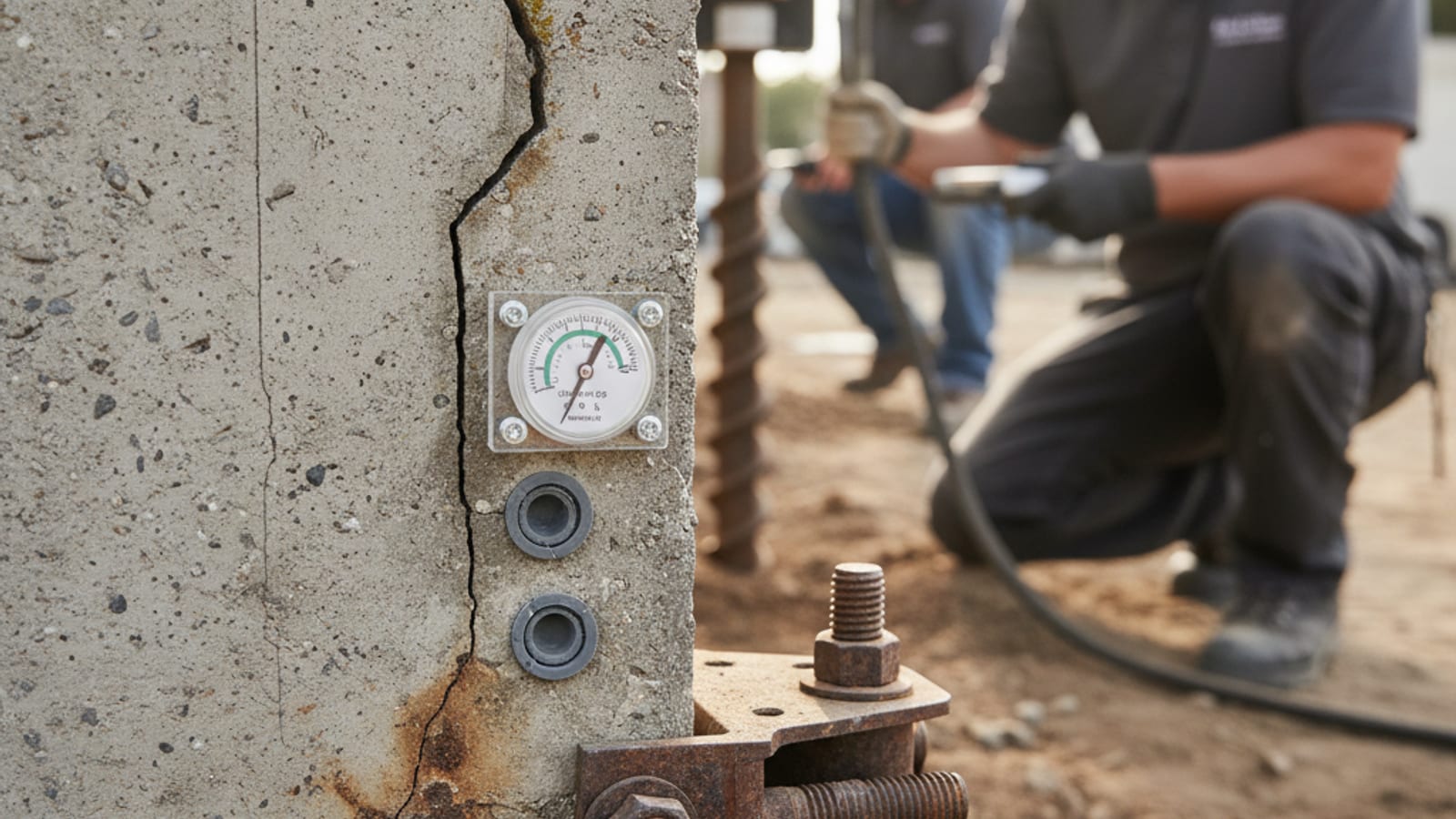
Not every foundation crack is a foundation problem. Concrete cracks. It’s what concrete does. The question is which kind of crack you have, what’s causing it, and whether the cause is going to keep going.
Here are the seven crack types that show up on San Diego foundations, what each one means, and what the right response is.
1. Vertical hairline cracks
Thin (under 1/32 inch), evenly spaced, often appearing within the first year of a pour. Almost always shrinkage cracks: as concrete cures, it loses water and shrinks, and the cracks relieve the internal stress.
What it means: cosmetic. The concrete is stable. Repair? Optional. Surface seal with a flexible patch product if you want the cosmetic improvement, especially if water can find them.
2. Diagonal cracks
Run from a high point to a low point at roughly 30 to 60 degrees off vertical. Often start at corners of doors, windows, or where two slabs meet.
What it means: structural. Diagonal cracks form when one part of the foundation drops relative to another part. They’re a sign the foundation is moving differentially, one side relative to the other. Repair? Usually yes, after the cause is addressed. Crack injection alone won’t solve it if the foundation is still moving. Diagnose with a level survey and crack monitoring.
3. Horizontal cracks
Run roughly parallel to the floor or grade, often at the midpoint of a wall.
What it means: lateral pressure. The wall is being pushed inward by soil, water, or a combination. On stem walls, horizontal cracks mean soil pressure exceeded the wall’s design. On retaining walls, they mean drainage failed and hydrostatic pressure built up. Repair? Yes, urgently. Horizontal cracks are the most serious crack type because they indicate ongoing structural failure under load. Carbon fiber straps, helical tieback anchors, or partial wall rebuild depending on severity.
4. Stair-step cracks (in brick or block walls)
Climb diagonally through mortar joints in brick or CMU walls, or follow lathe lines in stucco.
What it means: structural. Stair-step cracks are diagonal cracks in disguise. They follow the path of least resistance through the mortar instead of cutting through the brick face. Repair? Yes, after diagnosing the underlying movement. Tuckpointing or repointing alone seals the crack but doesn’t address the cause.
5. Cold joint cracks
Run along the seam where two pours meet: slab-to-stem-wall, garage cold joint, footing-to-wall. Hairline at this joint is normal.
What it means: depends on width and offset. Hairline (under 1/32 inch) with no offset is cosmetic. Wide (over 1/16) or offset (one side higher) is settlement of one of the two pours relative to the other. Repair? Inspect first. Cosmetic versions get a flexible joint sealant. Settlement versions need underpinning.
6. Active leaking cracks
Any crack (vertical, diagonal, or horizontal) that is wet during or after rain, or that has efflorescence (white salt deposits) along its edges.
What it means: the crack is open through the full thickness of the foundation, water is moving through it, and the situation is going to get worse before it gets better. Water coming through a crack accelerates corrosion of any rebar nearby. Repair? Hydrophobic polyurethane injection. Polyurethane expands when it contacts water, sealing the crack against ongoing leaks. Followed by addressing the source of water (drainage retrofit, grading, gutters) so the next crack doesn’t start the same cycle.
7. Pattern cracks (a web of small cracks across a slab)
Often shallow, web-like, never widening past hairline. Most common on slab surfaces, especially exposed garage and patio slabs.
What it means: surface curing issues, usually from too-rapid drying during the original pour. Sometimes called “crazing” or “map cracks.” Repair? Cosmetic only. Surface seal or topping if appearance matters. Structurally irrelevant.
How to measure a crack
Three numbers tell you what you need to know:
- Width: measure with a feeler gauge or a credit card. Edge of a credit card is roughly 1/32 inch (the threshold for “monitor”). Two credit cards stacked is roughly 1/16 (the threshold for “call us”).
- Length: end-to-end. Most repair quotes are linear-foot based.
- Vertical offset: is one side of the crack higher than the other? Run a fingernail across the crack. If it catches on a step, you have offset. Any visible offset is structural-suspect.
Document each crack with a photo and a date written next to it on a sticky note in the photo. That gives you a baseline to compare against in 60 to 90 days.
When to repair, when to monitor
Repair now:
- Any horizontal crack
- Any actively leaking crack
- Any crack with vertical offset
- Diagonal cracks at door or window corners that have widened in the last 6 months
- Any crack wider than 1/16 inch
Monitor and re-check at 60 and 90 days:
- Diagonal cracks that have not visibly widened
- Cold joint cracks under 1/16 inch
- Stair-step cracks that have not propagated
Cosmetic, no urgency:
- Hairline shrinkage cracks
- Pattern cracks on slab surfaces
- Hairline cosmetic cracks at corners of additions or bumpouts
The big mistake: repair without diagnosing the cause
Crack injection on a foundation that is still moving is a temporary fix. Within 12 to 24 months, a new crack will appear adjacent to the injected one. The injection wasn’t wrong; it just didn’t address why the crack appeared in the first place.
Before injecting, three questions:
- Is the foundation still moving? (Crack monitor for 60-90 days.)
- What’s causing the movement? (Soil, drainage, plumbing leak, settlement, hydrostatic pressure.)
- Will the cause continue? (Drainage that hasn’t been corrected, expansive clays in a drought cycle, etc.)
Answering those three questions is what separates a one-and-done repair from a recurring problem.
If you’re not sure what crack type you have, send us photos. Free consultation, no pressure.