Foundation movement rarely announces itself. By the time a homeowner notices something is wrong, the foundation has usually been moving for months or years. The good news: every kind of foundation problem leaves clues, and most of them are visible from a casual walk through the house. You don’t need a level survey to spot the early signs.
Here are the 10 most-overlooked indicators we see when we do free inspections in San Diego County, in roughly the order they show up.
1. Doors that used to close clean and now stick
The earliest sign in most homes. A door that hits the latch plate or drags on the carpet didn’t change. The frame moved. Doors fail in a specific pattern: the top corner that drops moves first, the latch goes out of alignment, then the door rubs along the bottom. If three doors on the same side of the house all stick, the foundation under that side has likely moved.
2. Diagonal cracks at door and window corners
Look at the corners of every door and window in the house. A vertical hairline crack is shrinkage and usually cosmetic. A diagonal crack running down and out from a corner is structural. It means the wall above the corner is being pulled apart by movement below. These widen seasonally as soils swell and shrink. Width over 1/16 inch (about a credit card edge) is a “call us” threshold.
3. Floors that slope visibly
Roll a marble across the floor in each main room. If it picks up speed on its own and rolls in a consistent direction, the floor slopes. A slope of 1 inch over 20 feet is the rough threshold where most homeowners start to notice it underfoot. More than that and you can see it standing still.
A Zip Level or rotary laser is the professional version of the marble test, and it’ll quantify what the marble showed you.
4. Gaps between baseboard and floor
A 1/8-inch gap that opens between the baseboard and the floor in the middle of a wall (not at the corner) is a sign that the floor has dropped. The baseboard is nailed to the wall, the floor moved out from under it. Gaps at the corners are usually shrinkage and less alarming.
5. Cracks in stucco or brick that run in a stair-step pattern
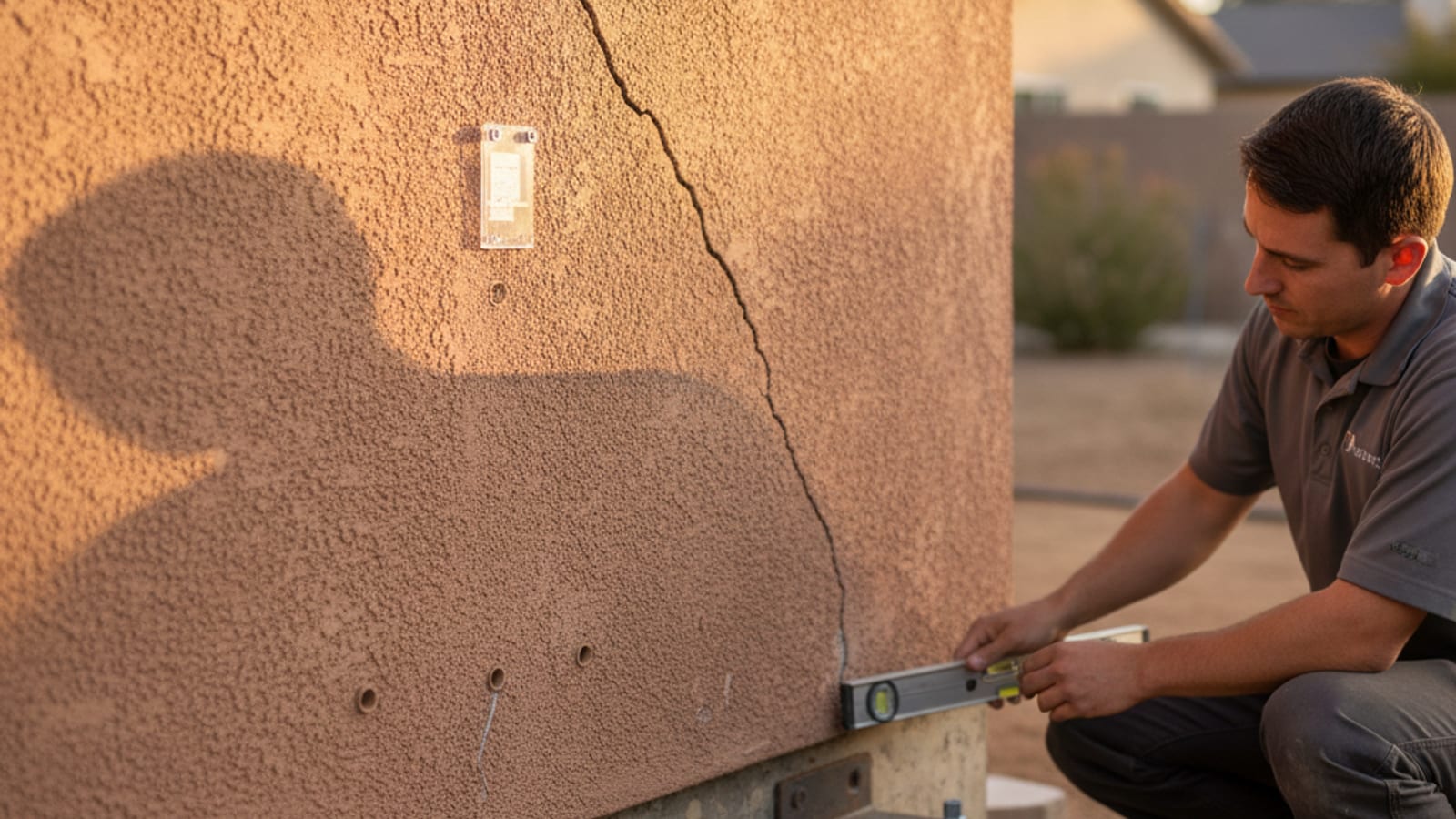
Stair-step cracks follow the mortar joints in brick or block walls, or the lathe lines in stucco, climbing diagonally. They mean the wall is shearing along its weakest line. Stair-step cracks at corners of the house, especially low on the wall near the foundation, are a specific concern.
6. The slab-stem-wall joint pulling apart
On slab-on-grade homes, look at the joint where the concrete slab meets the perimeter stem wall. A clean, tight joint is what you want. A visible gap, especially one that lets water through during rain, means the slab and the stem wall are no longer moving as a unit. Common in coastal homes after heavy winter storms.
7. The garage cold joint cracking through
Most garage slabs have a cold joint where the slab meets the perimeter footing. Hairline cracking at this joint is normal. A wide, offset crack that you can see daylight through, or a crack with one side visibly higher than the other, is settlement.
8. Tile or hardwood that has cracked in a line
Tile cracks in a straight line (not a random web of cracks) usually trace a foundation crack underneath. Same with hardwood that has buckled along a single line. It’s the slab telling you what it’s doing through the finish floor on top of it.
9. Sticking windows that used to slide easy
Same logic as doors. A double-hung window that won’t slide all the way up, or a casement that won’t swing closed, is telling you the frame is no longer square. The frame got out of square because the wall moved. The wall moved because the foundation under it did.
10. A new or widening efflorescence stain on the foundation
White, salt-like deposits on the foundation wall indicate water has moved through the concrete and evaporated, leaving the salts behind. New efflorescence means water is finding a new path, usually through a developing crack or at a drainage failure point. Worth investigating before the path opens further.
How to tell which ones can wait
Three quick tests:
Active vs. stable. Tape a quarter on a hairline crack with the edges of the quarter aligned to the crack edges. Come back in 60 days. If the crack has widened past the quarter, it’s actively moving. If the alignment is still tight, the crack has likely stabilized.
Pattern vs. one-off. A single sticking door is probably a humidity issue. Three sticking doors on the same side of the house in the same season is a foundation pattern.
Severity threshold. Cracks under 1/32 inch (about a hairline) are cosmetic. Cracks 1/32 to 1/16 are watch-and-monitor. Cracks over 1/16 inch are call-us. Vertical offset between the two sides of any crack, one side higher than the other, is call-us regardless of width.
The middle answer: monitor before repair
Not every foundation problem needs immediate repair. Many San Diego homes show movement that’s already stabilized: the house settled, the cracks formed, the movement stopped, and the house has been quiet for years. Those homes don’t need underpinning. They need crack injection at most, sometimes nothing at all.
The way to know which case you have is monitoring. Crack-monitor gauges (small acrylic plates that measure crack width to 1/100 inch) installed at key cracks, re-read at 60 and 90 days. Flat readings = stable, repair when convenient. Widening readings = active, repair sooner rather than later.
We install crack monitors on every inspection we do, free, whether or not you decide to hire us for repair.
When in doubt, get a level survey
The free 30-to-60-minute inspection at your home includes a level survey across the slab and floor system. We can tell you in one visit whether you have an active problem or a stable old movement, and what the right next step is, even if that step is “do nothing for now.”
Better than guessing from a Google search.