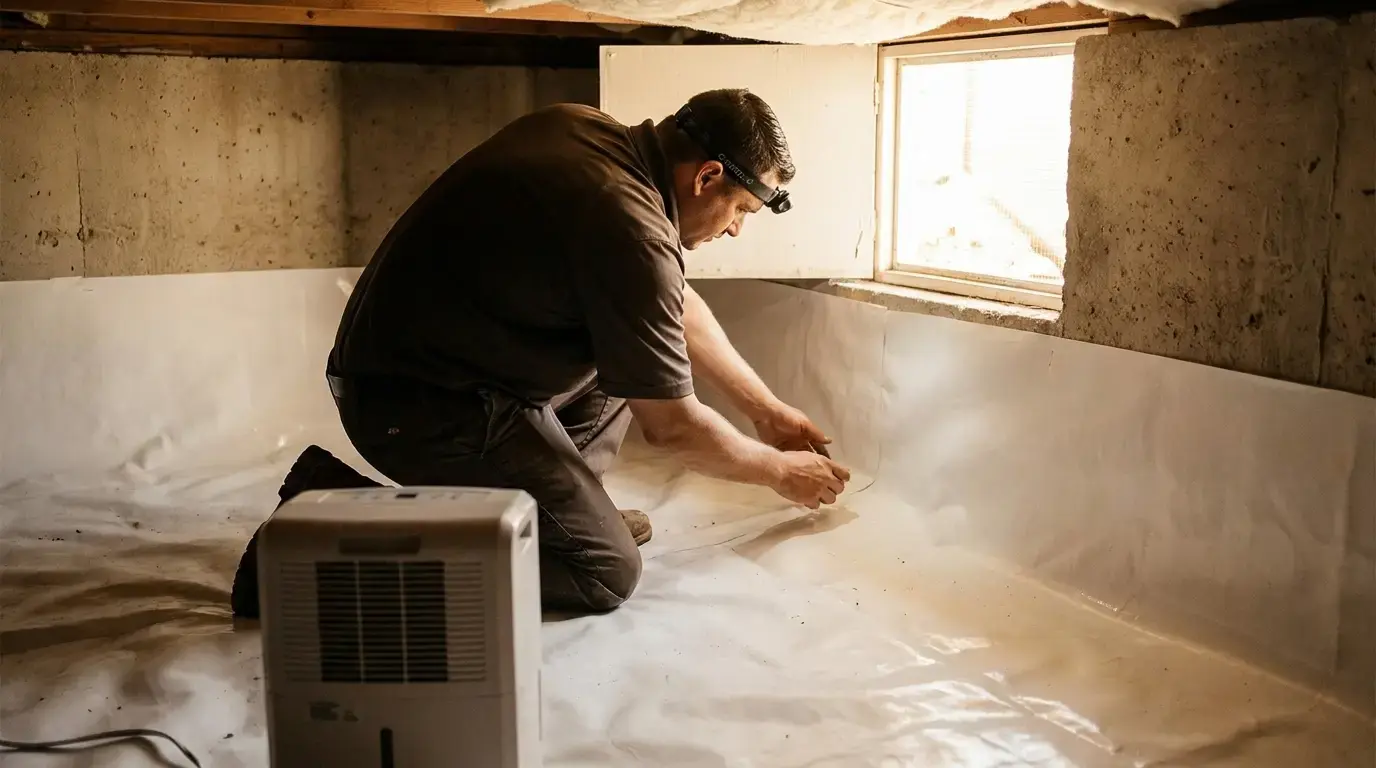
Crawl space encapsulation is genuinely worth it for some San Diego homes, but not most. The honest answer is that many local homeowners need better drainage and a basic vapor barrier, not a full encapsulation system. If you’re seeing musty odors, wood rot, or standing water under your house, keep reading. If a contractor pushed full encapsulation without inspecting your drainage first, that’s a red flag.
Here’s what you actually need to know before spending money under your house.
What crawl space encapsulation actually is
Encapsulation means sealing your crawl space completely. A thick plastic vapor barrier (typically 12 to 20 mil polyethylene) covers the ground and wraps up the foundation walls. Vents get sealed. A dehumidifier runs continuously to control humidity in the sealed space.
It’s a system, not just a product. Done right, it creates a conditioned or semi-conditioned zone under your home that stays dry year-round.
That’s different from a basic vapor barrier, which lays a thinner plastic sheet on the crawl space floor but leaves vents open. It’s also different from crawl space repair, which addresses structural damage like rotted beams, failing piers, or sagging joists.
Encapsulation deals with moisture control. Repair deals with damage already done.
Why the Southeast playbook doesn’t always apply here
Full encapsulation became standard in humid states like North Carolina, Georgia, and Tennessee. Crawl spaces in those climates deal with constant high humidity, frequent rain, and warm ground temperatures that pull moisture up year-round. Sealing everything out makes obvious sense.
San Diego is different. Our average annual relative humidity runs lower, we get less than 11 inches of rain most years, and our coastal climate is mild rather than oppressive. In many inland neighborhoods like El Cajon, Santee, and Lakeside, a crawl space can stay reasonably dry without a full encapsulation system.
That doesn’t mean encapsulation is never needed here. It means you should evaluate your specific conditions before committing.
When a San Diego home actually needs encapsulation
These are the real triggers. If two or more apply to your home, a full encapsulation system is likely worth serious consideration.
Standing water or persistent dampness. Water under your house after any rain, or ground that never fully dries out, signals drainage failure. Encapsulation alone won’t fix drainage, you’ll need to address that first with a proper drainage system. But once drainage is corrected, sealing the space keeps residual moisture from causing ongoing damage.
Wood rot or deteriorating subfloor materials. If a crawl space inspection finds softening joists, rotted sill plates, or deteriorating subfloor sheathing, moisture has already been working on your structure for a while. Encapsulation stops the source.
Musty odors inside the house. Air in your crawl space migrates up through the floor. If it smells like mildew down there, it’s affecting your living space. This is common in older Craftsman and post-WWII ranch homes with raised foundations.
Coastal location. Homes in Coronado, Ocean Beach, Encinitas, and Solana Beach deal with higher ambient humidity and salt air. Even in dry years, ocean-adjacent properties can see elevated moisture levels under raised foundations.
Pest activity. Termites and rodents love damp, dark crawl spaces. Encapsulation removes the moisture conditions they prefer and gives you a sealed, inspectable surface where evidence of entry is easier to spot.
History of slab leaks or plumbing issues. If you’ve had water from a slab leak migrate into a crawl space zone under a raised section of your home, the residual moisture can persist for months without intervention.
How encapsulation connects to foundation health
This is the part most homeowners miss. Moisture under a home doesn’t just rot wood, it affects the soil your foundation sits on.
Expansive soils in parts of San Diego County absorb water and swell, then shrink as they dry. That repeated movement stresses foundation footings and piers. Homes on raised foundations with chronically damp crawl spaces often show signs of differential settlement over time: sticking doors, sloping floors, cracking drywall.
Controlling crawl space moisture is one piece of a broader foundation waterproofing strategy that keeps soil conditions stable. It’s not a substitute for addressing drainage or structural issues, but it’s a meaningful part of a long-term plan.
If you’re also seeing cracks in your foundation walls or evidence of shifting, read our guide to foundation waterproofing and our breakdown of water and drainage problems around the house, moisture management starts outside the foundation, not just under the floor.
The encapsulation process, step by step
A proper installation follows a consistent sequence:
- Inspect and address any existing drainage problems outside the home
- Remove debris, old insulation, and deteriorated vapor barrier material from the crawl space
- Repair any active wood damage or structural issues
- Install a thick polyethylene liner across the entire floor, overlapping seams by 12 inches or more and taping them sealed
- Run the liner up foundation walls and secure it with adhesive and fasteners
- Seal or condition all vents
- Install a dehumidifier sized for the square footage of the space
- Add a condensate drain or pump so the dehumidifier doesn’t need manual emptying
The process typically takes one to two days depending on access and the condition of the space going in.
What it costs in San Diego
Cost varies based on crawl space size, accessibility, condition of the space, and whether drainage work is needed first.
| Scope | Typical range |
|---|---|
| Basic vapor barrier only (6 mil, open vents) | $800 to $2,500 |
| Mid-grade vapor barrier + vent sealing | $2,000 to $5,000 |
| Full encapsulation with dehumidifier | $5,000 to $15,000+ |
| Drainage correction (if needed first) | $2,000 to $8,000 additional |
These are general market ranges. Your actual cost depends on crawl space square footage, how many vents need sealing, dehumidifier size, and whether structural repairs are needed before encapsulation begins.
Get quotes from contractors who inspect the space in person first. A quote without a site visit isn’t worth much.
When you probably don’t need full encapsulation
Be honest with yourself here. Full encapsulation is a premium solution that makes sense in specific conditions. A lot of San Diego homes don’t have those conditions.
If your crawl space is dry, well-ventilated, and showing no signs of moisture intrusion, wood deterioration, or pest activity, a basic vapor barrier refresh and a drainage check may be all you need. That’s a few hundred to a couple thousand dollars, not ten thousand.
If your main issue is drainage around the foundation perimeter, fix the drainage first. No amount of sealing the interior will compensate for water pooling against your foundation walls from outside.
And if you’re seeing actual structural damage under your home, bouncy floors, tilted piers, rotted beams, start with crawl space repair before spending money on encapsulation. Sealing a damaged structure doesn’t fix it.
Get an honest look under your home
The only way to know what your crawl space actually needs is to get eyes on it. A free inspection from Base Pro San Diego includes a look at moisture conditions, wood health, drainage patterns, and any signs of foundation movement.
We’ll tell you what we find and what it means, including when the answer is “you don’t need encapsulation right now.”
Call us at (858) 925-5546 or reach out online to schedule your free crawl space inspection.