Almost every foundation problem we see in San Diego County has water somewhere in the story. Even in a county where it doesn’t rain much, the rain we do get tends to come in pulses (4 inches in 24 hours during an atmospheric river) that overwhelm undersized drainage and pile water against the house.
Foundation damage doesn’t usually happen during the storm. It happens over the years that follow, as water repeatedly works on the soil under and around the foundation.
Here’s how drainage drives foundation problems, and four interventions that solve most of them.
Three ways water hurts a foundation
1. It wets expansive clay. As covered in our expansive clay post, wet clay swells and lifts whatever’s on top of it. Repeated wet/dry cycling fatigues structures.
2. It washes out fines. Soil under and next to a foundation contains fines, the silt and clay particles that hold the soil together. Water moving through the soil carries fines away, leaving voids. The void eventually loses bearing capacity and the soil collapses, dropping the slab into it.
3. It builds hydrostatic pressure. Water against a stem wall or retaining wall has weight. Saturated soil weighs roughly twice as much as dry soil. A wall designed for dry soil pressure can fail under wet soil pressure: bulging, cracking horizontally, eventually leaning.
Where water comes from (in order of frequency)
Roof water that doesn’t get carried away. Downspouts that dump at the foundation, gutters that overflow, no tight-line piping. Roughly 60% of the foundation water problems we see start here.
Surface runoff toward the foundation. Hillside lots with uphill runoff. Hardscape (driveway, patio) graded toward the house instead of away. Reverse-graded landscape beds.
Plumbing leaks. Slow leaks in supply or drain lines under or next to the foundation. Hot water lines especially, since the heat accelerates corrosion of copper and the warmer water carries fines faster.
Irrigation overspray. Sprinklers hitting the side of the house, drip lines running too long, broken heads spraying continuously. Irrigation is the #1 source of “constant” water in many San Diego foundation problems.
Groundwater. Less common in most of San Diego County, but real on some lots: old creek beds, fill over groundwater zones, hillside seeps. Requires geotechnical investigation.
The four interventions that solve most problems
1. Corrective grading
The first 10 ft of soil around the house should slope away from the foundation, minimum 6 inches drop in 10 ft. Most older homes don’t have this. Landscape, additions, and settlement have all worked against the original grading.
Cost: $1,500-$5,000 depending on extent. The cheapest, highest-impact drainage intervention.
2. Downspout extensions and tight-lining
Every downspout should discharge at least 5 ft from the foundation (10 ft preferred), via either a flexible extension or a buried tight-line PVC pipe to a daylight or catch basin.
Tight-lined downspouts are the gold standard. Buried 3-inch or 4-inch PVC, sloped to a daylight at a downhill swale or curb. No annual maintenance, no winter blockage, no kicked-out flexible extensions.
Cost: $250-$600 per downspout for tight-line, less for flexible extensions.
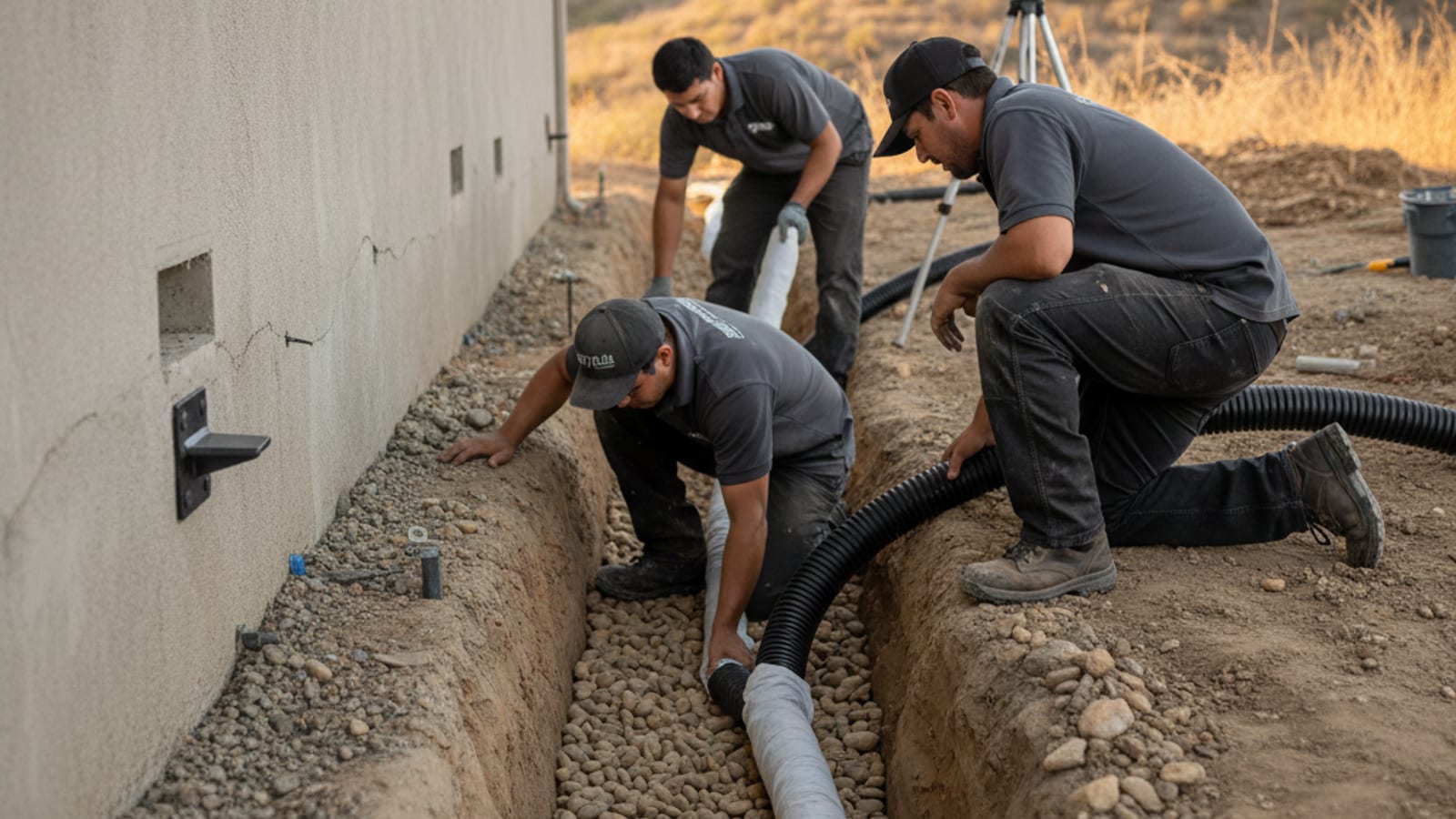
3. Perimeter French drain
For hillside lots, basement walls, and chronic-moisture crawl spaces. A 4-inch perforated PVC pipe at the footing depth, surrounded by clean washed stone, wrapped in a filter sleeve, daylighted to a downhill discharge or a sump.
Properly built, lasts 40+ years. Improperly built (corrugated thin-wall pipe, no filter, no daylight, dirt around the pipe) lasts 5 years.
Cost: $90-$180 per linear foot for full perimeter. Most homes that need a French drain need it on one or two sides, not all four.
4. Sump pump system
Last resort, used when daylight discharge isn’t possible (basement homes, low-lying lots, no downhill). A pit at the lowest interior point, perforated drain lines feeding it, a pump that lifts water out to a discharge point.
Reliable but high-maintenance: annual pump check, battery backup recommended, alarm for failure detection.
Cost: $2,500-$6,500 installed.
Why San Diego drainage gets undersized
Two reasons:
Original construction during dry years. Many San Diego tracts were built during multi-year droughts. Builders sized drainage for the conditions they observed, not the design storm. When the wet years came back, the drainage was undersized.
Hardscape additions over the years. Original yards were mostly soil and lawn (permeable). Owners added pools, patios, walkways, driveways, and decking. Each addition reduced infiltration capacity and increased runoff to the remaining soil, usually the perimeter against the house.
A drainage retrofit on a 30-year-old San Diego home is rarely about fixing a contractor mistake. It’s about updating to match how the lot is being used now.
When drainage fixes the foundation problem (no underpinning needed)
For about 30-40% of the foundation problems we inspect, drainage retrofit alone stabilizes the situation. Specific cases:
- Active leaking cracks in dry-side foundation walls: stop the water, the cracks stop spreading
- Slab voids from washout: stop the water source, fill the existing voids, no underpinning needed
- Seasonal door-sticking and minor cracks on expansive clay: control moisture, control the cycling
- Hillside slope creep: stop the water in the slope, the creep stops accelerating
For the other 60-70%, drainage is part of the solution but underpinning is also needed. Doing one without the other is half a repair.
What to ask a contractor about drainage
- “Where will the water actually go?” If they can’t trace the discharge path on a site walk, they’re guessing.
- “Daylight or sump?” Daylight always wins when the lot allows. A contractor who defaults to sump is selling pumps.
- “Schedule 40 PVC or corrugated?” Schedule 40 lasts decades. Corrugated is cheap, kinks easily, and holds sediment.
- “Filter sleeve around the stone?” Yes. It keeps fines out of the pipe. Without it, the drain silts up in 5-10 years.
- “How will you backfill?” Clean stone all the way up to within 6 inches of grade, then native soil. Filling with native dirt against the pipe defeats the design.
DIY-able vs. hire-it-out
Reasonable DIY:
- Downspout extensions (above ground, flexible)
- Surface re-grading of small landscape beds
- Cleaning out existing French drain catch basins
- Installing simple surface drains in existing catch points
Hire it out:
- Tight-lining downspouts (excavation, slope, tie-in)
- Perimeter French drains (depth, equipment, slope to daylight)
- Sump pump systems (electrical, code, discharge)
- Anything within 5 ft of the foundation footing (mistake risk too high)
Free drainage assessment with every foundation inspection
When we do a foundation inspection, drainage assessment is included: grading, downspouts, hardscape, irrigation, and root cause analysis if water is part of the problem. We tell you what’s needed, what’s optional, and what you can DIY.
Drainage retrofit alone is sometimes the right answer. Underpinning + drainage is sometimes the right answer. Underpinning alone is almost never the right answer when water is part of the story.