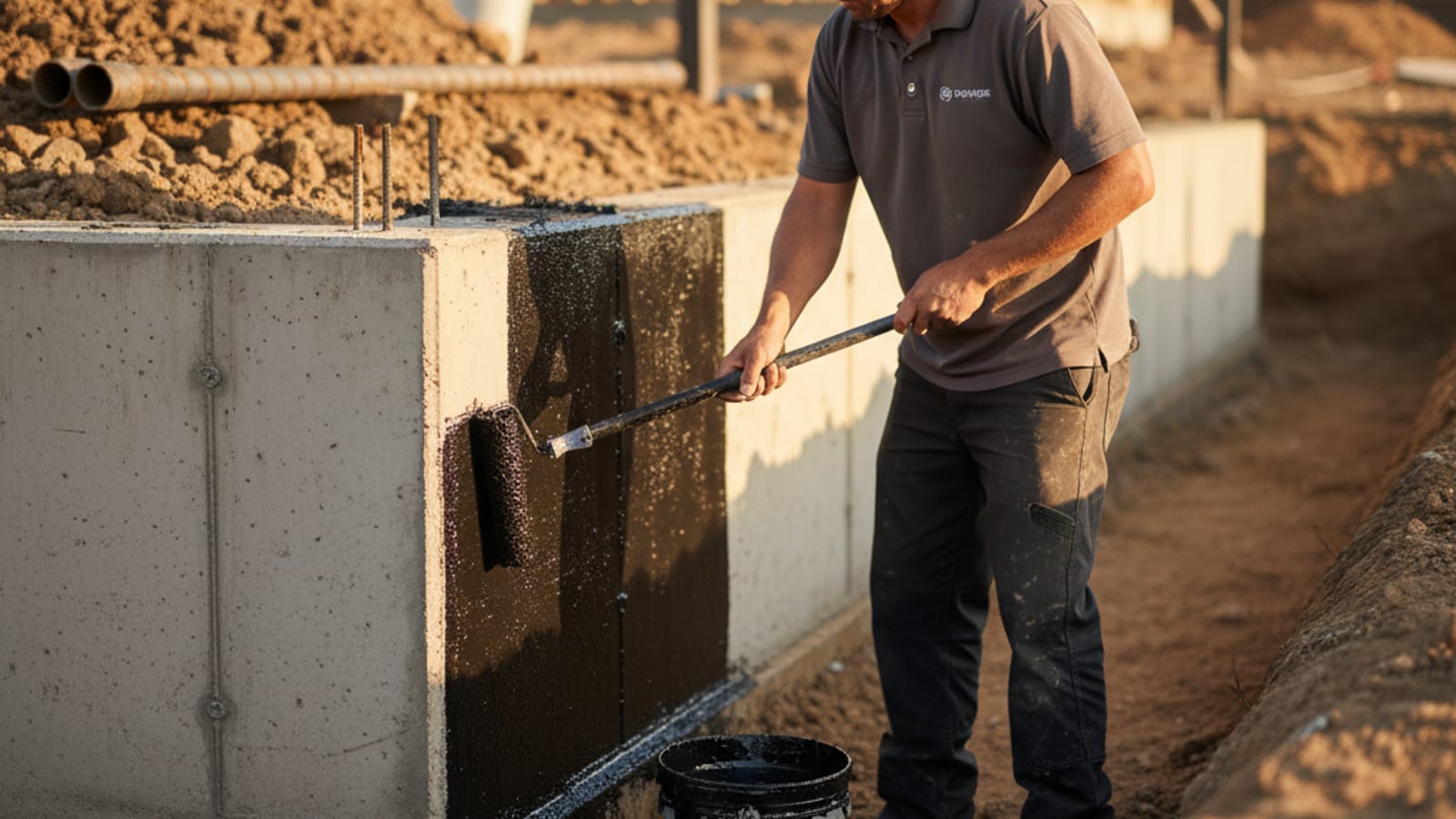
San Diego doesn’t get much rain. So most homeowners assume foundation waterproofing isn’t a real concern here. They’re mostly right and partly wrong.
The “mostly right” part: full basement waterproofing (membranes, drainage planes, perimeter drains, sump systems) is overkill for the average San Diego slab-on-grade home on a flat lot.
The “partly wrong” part: hillside lots, basement homes, daylight basements, and homes near lagoons or old creek beds all see real water against the foundation during winter storms. And the consequences of ignoring it accumulate.
Here’s when waterproofing actually matters in San Diego, and what to do about it.
When you need waterproofing
You probably need it if:
- You have a basement, daylight basement, or partial basement with finished space below grade
- Your crawl space gets wet, muddy, or musty after winter rain
- Your stem wall shows efflorescence (white salt deposits) on the interior face
- You have an actively leaking foundation crack
- Your hillside lot has uphill drainage shedding toward the foundation
- You’re doing a foundation repair anyway and want to address moisture as part of the job
You probably don’t need it if:
- You’re on a flat lot with good drainage and never see water against the foundation
- Your slab-on-grade home has a tight slab-stem-wall joint with no efflorescence
- Existing drainage is working and you have no symptoms of moisture intrusion
Exterior vs. interior waterproofing
The biggest decision in any waterproofing job:
Exterior (positive-side) waterproofing stops water before it reaches the foundation wall. The membrane sits on the exterior face of the wall, with a drainage plane and perimeter drain at the footing.
Always better when access exists. The water never touches the structural wall, so you avoid the slow degradation that happens when concrete is repeatedly saturated.
Cost: $90-$180 per linear foot for full perimeter, depending on depth.
Interior (negative-side) waterproofing keeps water from coming through the wall into the interior space. The membrane goes on the inside face, with a perimeter drain inside the building feeding a sump.
Used when exterior excavation is impossible: finished hardscape, property line walls, deep basements, neighbors too close. The wall still gets wet (you didn’t stop the water from reaching it), but the inside stays dry.
Cost: $80-$150 per linear foot for the perimeter system, plus sump.
Materials, briefly
For exterior waterproofing:
- Sheet membranes (Bituthene, Carlisle CCW MiraDRI, Mar-flex Shark Skin): peel-and-stick rubberized asphalt or HDPE. 10-25 year warranties. Most common on new construction and full retrofits.
- Liquid-applied (Tremco Tuff-N-Dri, Polyguard Polywall, Mar-flex 5000): sprayed or rolled. Flexible, good at corners and penetrations. Comparable warranty.
- Cementitious (Xypex, BASF MasterSeal): a slurry that crystallizes inside the concrete. Used on basement walls where the concrete itself becomes the waterproofing.
For interior waterproofing:
- Drainage matting (Delta-MS, Platon): dimpled HDPE that creates a drainage plane against the inside wall, channeling water down to a perimeter drain.
- Cementitious coatings: the same family as the exterior versions, applied inside.
- Crystalline injection: for active leaks at specific points.
What waterproofing doesn’t fix
Three common misunderstandings:
Waterproofing doesn’t fix structural cracks. A cracked foundation that’s actively moving needs the structural fix (crack injection, underpinning) plus waterproofing. Waterproofing alone seals the existing crack but doesn’t stop the movement creating new ones.
Waterproofing doesn’t compensate for bad drainage. If water keeps arriving at the foundation in volume, even good waterproofing is fighting an unnecessary battle. Address the drainage first; waterproofing is the last line of defense, not the only one.
Waterproofing doesn’t fix hydrostatic pressure on retaining walls. Walls fail from the soil pressure load, not from getting wet. Drainage relieves pressure; waterproofing keeps the wall dry. Different jobs.
When waterproofing pairs with foundation repair
We waterproof during foundation repair work in three common scenarios:
1. Hillside underpinning. When the pros we send excavate to install helical or push piers along a hillside foundation, the stem wall is exposed for the first time in decades. It’s the perfect window to add or replace exterior waterproofing while access is open.
2. Crack injection on an exposed wall. Hydrophobic polyurethane crack injection plus a localized membrane patch on the exterior face = belt-and-suspenders for an active-leak crack.
3. New drainage installation. A new perimeter French drain at the footing allows us to add or refresh the membrane against the stem wall as a single combined retrofit. Cheaper than doing them separately.
Common San Diego waterproofing scenarios
The Encinitas/Cardiff coastal home with a daylight basement. Built into a coastal bluff, partially below grade, vulnerable to lateral water intrusion from rare heavy storms. Full exterior membrane + perimeter drain on the uphill side, daylighted to the downhill side.
The Lakeside or Alpine hillside lot. House sits at a grade break with substantial uphill catchment. Driveway and patio collect runoff that finds the foundation. Surface drainage retrofit + exterior membrane on the uphill stem wall.
The Mission Hills or La Jolla older home with chronic crawl space moisture. Hardscape, mature trees, and original drainage that has long since silted up. Inside the crawl: vapor barrier replacement + interior perimeter drain to sump. Outside: corrective grading + downspout extensions.
The post-storm leaking crack. A specific crack that started weeping after this winter’s atmospheric river. Hydrophobic polyurethane injection + exterior membrane patch + downspout retrofit at the corner above the crack. Targeted, not a full perimeter job.
How to know if your existing waterproofing has failed
Symptoms:
- New efflorescence on interior walls or floors
- Damp spots on basement or crawl space walls
- Water finding a new path during rain that didn’t appear in previous storms
- Standing water in the crawl after a moderate (1-2 inch) rainfall
- Mold or musty smell developing in below-grade spaces
Existing membranes typically last 25-50 years depending on product and installation. Hidden behind backfill, you usually only learn they’ve failed when symptoms show up inside. Replacement requires excavation back to the wall, the same cost as a new install.
Free assessment
Waterproofing is part of every foundation inspection we do. We’ll tell you if you actually need it, where, and what kind. For most San Diego homes the answer is “no, you don’t need full waterproofing,” and we’ll say so.
For the homes that do need it, we design from the cause backward: address the water source, install drainage, then waterproofing as final defense. In that order.