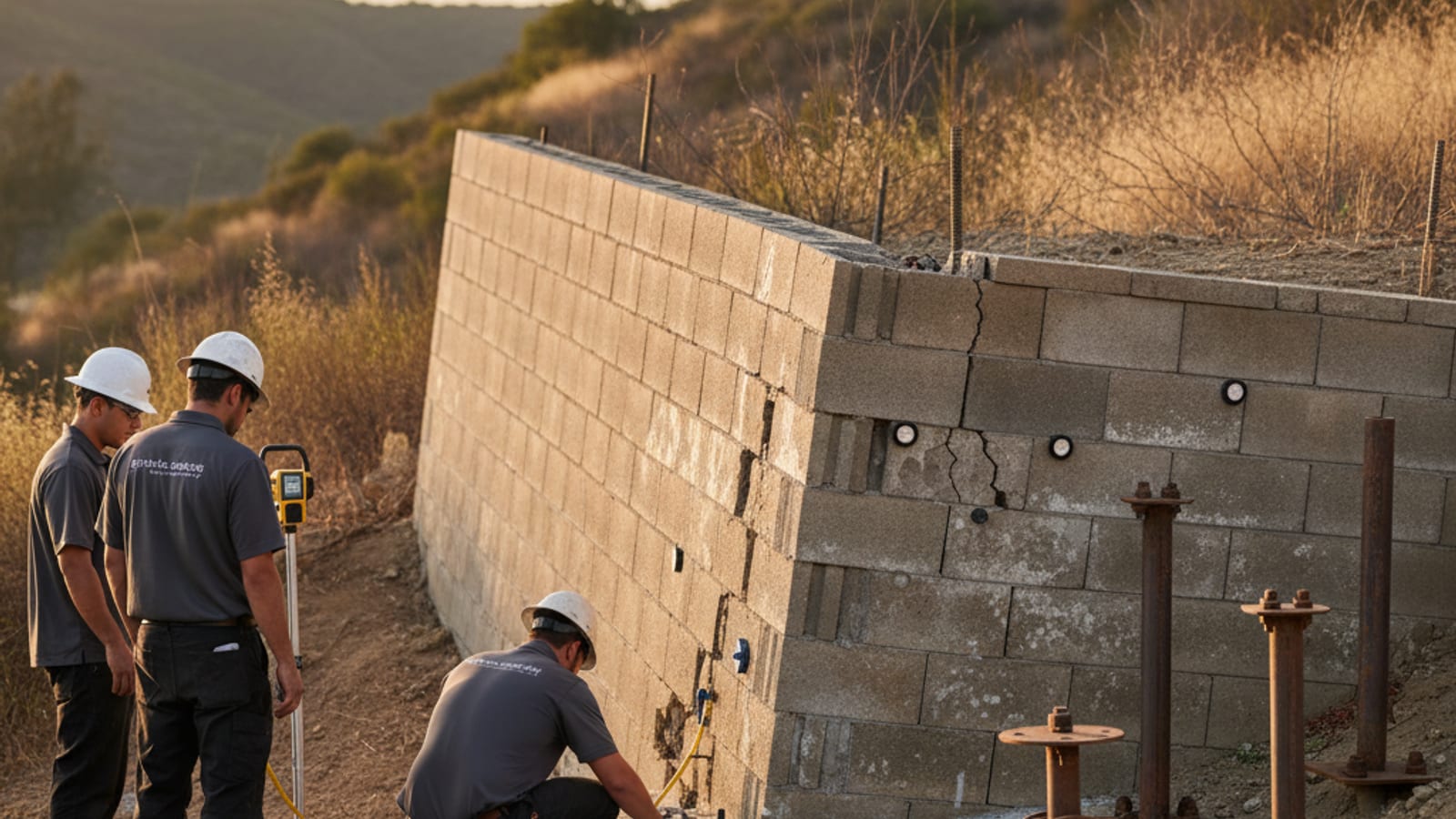
Retaining walls fail slowly, then all at once. The slow part (the lean, the cracks, the bulge) gives you months or years of warning. The all-at-once part is what happens when you ignore the warnings.
San Diego County has more failing retaining walls than any other in Southern California, mostly because the hillside development boom of the 1960s-80s built a lot of walls to inadequate engineering standards, with drainage that’s now silted up after 50 years of rain.
Here are the 8 signs that your retaining wall is failing, what each one means, and what to do about it.
1. Visible lean
Stand back from the wall and look at it from the side. A wall that’s leaning toward the downhill side has lost some of its capacity to resist soil pressure. A plumb laser or a long level against the wall face quantifies the lean.
Lean threshold:
- Under 1 degree (about 1 inch lean over a 5 ft wall): cosmetic, monitor
- 1 to 3 degrees: structural, repair within 12 months
- Over 3 degrees: imminent, repair now
A wall that’s leaning is doing exactly what failing walls do. The lean is the start, not the end.
2. Bulge in the middle
A wall that’s straight at the top and bottom but bulges outward in the middle is failing differently than a leaning wall. Bulge means the wall is being pushed by soil pressure but the top and bottom are restrained, so the middle gives because it’s the weakest section.
Bulge usually means hydrostatic pressure (water in the soil behind the wall) has built up beyond what the wall was designed for. Drainage retrofit is part of the answer; structural reinforcement is the other part.
3. Stair-step cracks running through the wall
Diagonal cracks that follow the lines of mortar joints (in CMU walls) or the natural stress lines (in concrete walls). They climb from corner to mid-wall.
Stair-step cracks indicate shear failure: the wall is sliding along its weakest line under load. Common in walls without adequate rebar or in poorly built old block walls.
4. Horizontal cracks
A horizontal crack across the face of a wall is one of the most serious failure modes. It indicates the wall has yielded under bending: soil pressure has pushed the wall hard enough that it’s rotating around the crack location.
Horizontal cracks rarely heal on their own. The wall is going to keep moving in the same direction until it fails or is repaired.
5. Active water through the wall
Weep holes that are constantly running, water seeping through cracks during dry weather, efflorescence streaks down the wall face. These are all signs that drainage has failed and water is moving through the wall instead of around it.
Constant water through a wall accelerates rebar corrosion, reduces concrete strength, and adds load via hydrostatic pressure. Water is rarely the cause of wall failure but it’s almost always an accelerant.
6. Soil disappearing on the uphill side
A noticeable depression developing behind the wall: soil settling, voids forming, or actual loss of material into the wall through cracks. Indicates the soil structure behind the wall is degrading and the wall is doing more work than designed.
Sometimes accompanied by hardscape settlement (driveway or patio dropping) on the uphill side.
7. Drainage system failure
Original drainage behind a wall (perforated pipe in stone, weep holes, drain rock backfill) has a service life of 20-40 years. After that, the pipe silts up, the stone gets fines in it, and water can no longer drain freely.
Symptoms: weep holes that have stopped flowing during winter rain, water emerging from unexpected points in or around the wall, persistent damp behind the wall.
A wall with failed drainage is a wall on borrowed time. Hydrostatic pressure builds, lean increases, cracks open. The cure is drainage retrofit before the wall fails structurally.
8. The neighbor’s wall is failing
If you share a property line with a hillside neighbor and their retaining wall is showing signs from above, your wall (downhill of theirs) is taking surcharge load it wasn’t designed for. Their failure becomes your failure on a delay.
Reverse case: your downhill neighbor’s wall failure removes lateral support from your soil, which increases the load on your wall.
Property-line wall situations are common in older San Diego hillside neighborhoods (Mission Hills, La Jolla, parts of El Cajon, Lakeside). Communication and coordination matter.
What to do when you see one of these
Severity 1 (monitor): Lean under 1 degree, hairline cracks, mild efflorescence. Photograph the wall, mark the cracks with a date, re-inspect in 6 months. If nothing has progressed, monitor annually.
Severity 2 (call us): Lean 1-3 degrees, cracks over 1/16 inch, drainage clearly failed, soil disappearing behind the wall. Repair within 6-12 months. Options: drainage retrofit, helical tieback anchors, carbon fiber straps, partial rebuild.
Severity 3 (urgent): Lean over 3 degrees, horizontal cracks, bulge, active water through cracks, visible movement between inspections. Repair now. Options: full demo and rebuild, or aggressive tieback + drainage if the wall is structurally salvageable.
Severity 4 (evacuate the area): Wall is visibly moving, soil is collapsing, the wall is over a structure or driveway, recent storm has accelerated the situation. Don’t park under it, don’t work next to it, repair on an emergency basis.
Repair tactics, briefly
Drainage retrofit. New perforated pipe, drain rock, weep holes, daylighted discharge. Sometimes done from the uphill side (excavate, replace, backfill), sometimes from the downhill side (core through the wall for new weeps + interior collection).
Helical tieback anchors. Steel anchors driven into competent soil behind the wall, hydraulically tensioned to pull the wall back to plumb (or just to hold it where it is). Per-anchor cost $1,200-$3,500 installed.
Carbon fiber straps. Bonded to the downhill face of the wall. Adds bending capacity. Limited to walls with intact concrete and minor structural deficits. Per-strap cost $400-$900 installed.
Soil nailing. For taller walls or walls with no exterior reaction space. Fully grouted soil nails installed through the wall face. Engineered, permitted, expensive. Per-nail cost $1,500-$4,000 installed.
Full rebuild. When the wall is past saving. Demo, re-engineer, build new with modern drainage, rebar, and engineering. Cost: $300-$700 per face foot of wall.
Permits and engineering
In San Diego County, walls over 4 ft (or shorter walls retaining a surcharge) require:
- Stamped engineered design
- Permit from the city or county
- Building department inspection during construction
Doing wall work without these is a common shortcut and a common liability. Unpermitted walls fail buyer inspections, void insurance, and create city violations that can bite you on resale.
The pros we send pull the permit, coordinate the engineer, and pass the inspection. End-to-end.
Free wall inspection
Same as foundation inspections: a free 30-60 minute walk-through with a verbal estimate, or a paid full inspection ($450 and up) with written report and photo documentation. Engineer-stamped reports available when needed.
If your wall is showing any of the 8 signs above, get an inspection now while options are still inexpensive. Walls that fail catastrophically cost 5-10x what an early intervention would have.