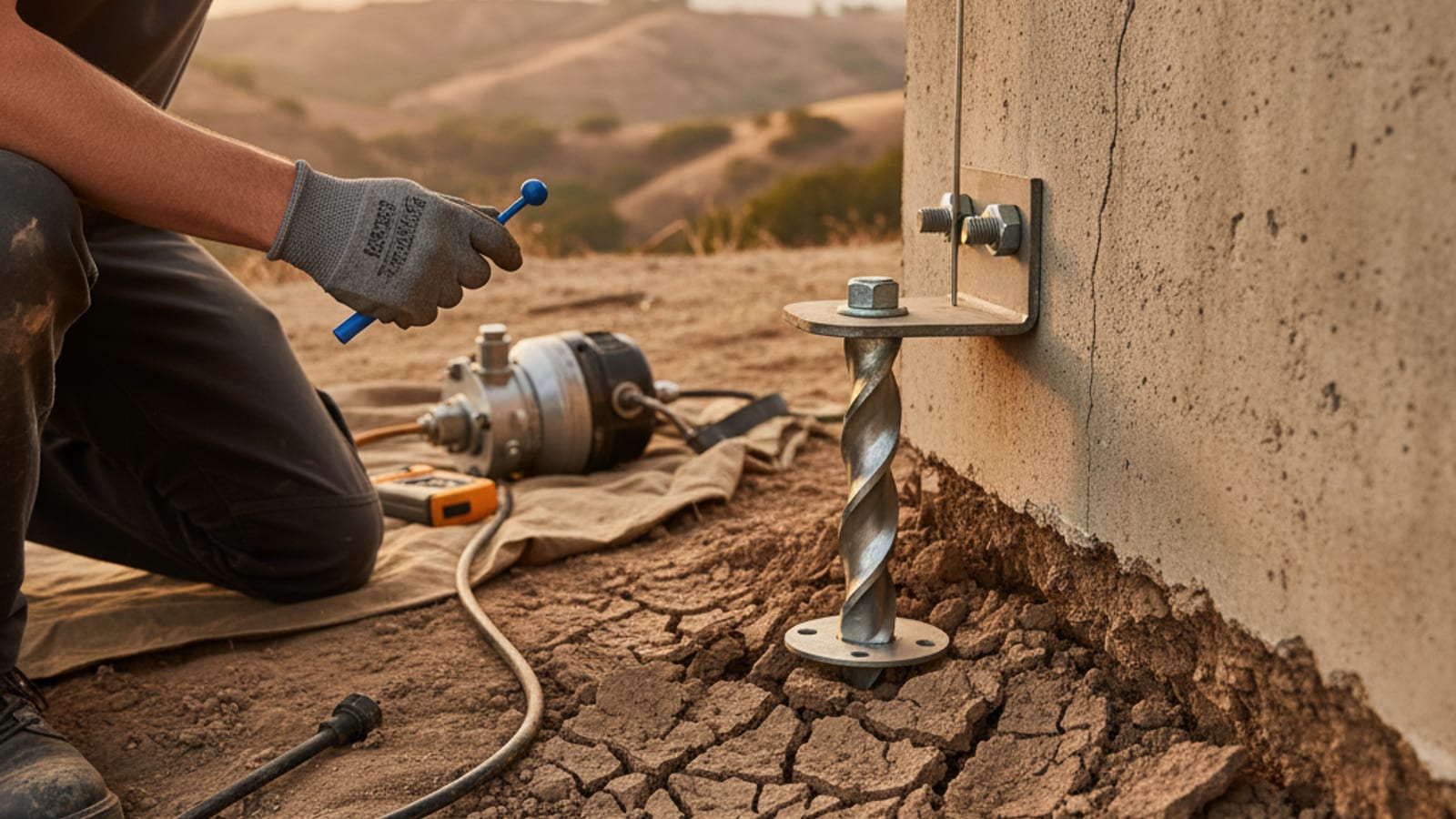
Walk around an inland San Diego neighborhood in late September. You’ll see cracks in the dirt: long, dry, crazed lines spreading across landscaping beds and side yards. Now go back in March, after a wet winter, and the same dirt has swelled, lifted hardscape an inch, and pushed against fence posts. That’s expansive clay, and it’s the single biggest driver of foundation movement in inland San Diego County.
If your home is in San Marcos, Escondido, Vista, Fallbrook, El Cajon, Lakeside, Alpine, or Ramona, there’s a real chance expansive clay is part of your foundation’s life. Here’s what it does and how to live with it.
What “expansive” means
Expansive clay is a specific type of soil (montmorillonite-group clays, also called smectites) whose individual particles absorb water between their layers. When wet, the clay swells by 10-30% of its dry volume. When dry, it shrinks back. The cycle repeats with every wet/dry season.
A foundation sitting on expansive clay rides this cycle. Wet winter: the clay swells under one corner of the house, lifting it. Dry summer: the clay shrinks, dropping that corner. Over years, the structure fatigues: drywall cracks, doors stick, mortar joints separate.
A home built on stable, non-expansive soil (decomposed granite, well-graded sand, properly compacted fill over good native soil) doesn’t ride this cycle. Same house, different lot, dramatically different long-term behavior.
Where expansive clay shows up in San Diego County
Not evenly distributed. The biggest concentrations:
- North County Inland valleys: San Marcos, Escondido, Vista, Fallbrook, parts of Bonsall and Valley Center. Sweetwater Reservoir watershed. Active alluvial deposits.
- East County valleys: El Cajon, Santee, Lakeside, parts of Alpine and Jamul. Sweetwater and San Diego River drainage.
- Inland South Bay tract fill: Older Chula Vista neighborhoods on graded clay.
- Hillside cuts: Anywhere a 1970s-80s tract was cut into a hillside, the cut sometimes exposed clay that was buried under decomposed granite.
Less common but present:
- Coastal terrace edges: Some lagoon-adjacent properties (parts of Carlsbad, Encinitas) sit on clay underlain by sandstone.
- Backcountry valleys: Ramona, parts of Julian, Warner Springs.
Mostly absent:
- Beach-front lots on sandy soil.
- Decomposed-granite foothills.
- Rock-outcrop mountain communities.
A geotechnical soils report is the only way to know for sure what’s under your specific lot. For most insurance and disclosure purposes, a recent (within 10 years) soils report is required anyway.
What clay movement does to a foundation
Three classic patterns, depending on the foundation type:
Slab-on-grade homes: the perimeter footing rides up and down with the clay. Center of the slab tends to stay still (it’s loaded by the structure but isolated from the clay by the slab itself). Result: the slab “domes” upward in winter (perimeter higher than center) and “saucers” downward in summer (perimeter lower). Cracks open and close at door corners on a seasonal cycle.
Raised foundations (post-and-pier): the perimeter stem wall and the interior post pads each ride independently. Stem wall lifts and drops with the clay; interior posts may not move as much because their pads are below the active clay zone. Result: floors tilt seasonally toward the perimeter and back.
Stepped/hillside foundations: different sections of the foundation ride different clay zones. The downhill side often experiences worse seasonal movement because soil moisture migrates downhill. Cracks form at the steps where two foundation elevations meet.
Why drainage is half the answer
The clay only swells if it gets wet. Control the moisture and you control most of the movement.
Three drainage interventions that change everything for a clay-soil home:
- Grading away from the foundation. The first 10 ft of soil around the house should slope down a minimum of 6 inches in 10 ft. Most older homes don’t.
- Tight-line downspout extensions. Roof water dumped at the downspout dies in the clay right next to the footing. Tight-line piping carries it 10+ ft away to a daylight or catch basin.
- Perimeter French drain. For homes with chronic moisture against the foundation, a 4-inch perforated pipe in clean stone, sleeved, daylighted to a downhill swale.
For roughly 30-40% of clay-soil foundation problems we see in San Diego County, drainage retrofit alone (no underpinning) stabilizes the movement enough that the homeowner can monitor for a few years before deciding whether structural repair is needed.
When drainage isn’t enough
If movement has already caused structural cracks, sloping floors over 1 inch in 20 ft, or active wall offset, drainage alone won’t reverse the damage. You need underpinning to get the foundation onto stable bearing below the active clay zone.
Helical or push pier underpinning targets bearing strata below the clay, usually 12 to 30 ft down in San Diego inland zones, where the clay transitions to weathered bedrock or stable older alluvium. Once piered, the structure no longer rides the seasonal clay cycle. Drainage retrofit goes in alongside the piers as belt-and-suspenders, but the structural movement is solved by the piers.
Crack injection happens last. Inject after the foundation is stable, not before. Otherwise the next seasonal cycle just opens a new crack adjacent to the one you just sealed.
Living with clay: what’s normal vs. what’s not
A clay-soil house will always have some cosmetic seasonal movement. Door that sticks for two months in winter and works fine the rest of the year? Probably normal. That’s the wall riding the clay cycle. Hairline cracks that open and close seasonally at the same locations every year? Annoying but not structural.
Structural concern threshold:
- Cracks that widen permanently year-over-year (not seasonal cycling but progressive)
- Floor slope that increases between annual measurements
- Doors that stick year-round when they used to be seasonal-only
- New cracks appearing in locations that didn’t previously crack
The way to know is documentation. Take a photo of every crack, with a date, every year at the same season (mid-summer, peak shrinkage). Compare. Static = stable. Progressive = call us.
Bottom line for clay-soil homeowners
You can’t change the soil. You can change three things:
- Keep moisture out of the active clay zone (drainage, grading, irrigation control).
- Get the structure onto stable bearing if the cycling has already done damage (underpinning).
- Document and monitor so you know what’s seasonal vs. progressive.
Free inspection includes a level survey, drainage assessment, and a recommendation on which of the three you actually need.