A slab leak is one of those problems where the visible damage looks small but the underlying damage is enormous. A high water bill, a warm spot on the floor, a hairline crack: innocuous symptoms that turn out to be the surface of a serious foundation issue.
Slab leaks are the single most common cause of localized foundation settlement in San Diego homes built from the 1960s through the early 2000s. Here’s how the damage happens, how to spot it early, and what the full repair sequence looks like.
What a slab leak is
A slab leak is a leak in a water supply line, drain line, or sewer line that runs through or beneath the concrete slab of your home. Most often it’s a copper supply line. Copper develops pinhole leaks from internal corrosion, abrasion against the slab, or external corrosion from soil chemistry.
Once the leak starts, water escapes into the soil beneath the slab continuously. The leak might lose half a gallon a day, or 50 gallons a day, depending on the size of the failure and the line pressure.
You don’t see the water. It travels through the soil, follows the path of least resistance, and exits somewhere: sometimes into a storm drain, sometimes pooling in a low spot on the lot, sometimes never visibly emerging.
What it leaves behind is the problem.
How a leak damages the foundation
Water flowing through soil for months or years carries fines (silt and clay particles) with it. The fines get deposited downstream while the soil under the slab loses material. A void develops.
Voids under a slab range from a few inches deep to several feet. As long as the void is small, the slab spans across it without obvious symptoms. As the void grows, the slab eventually loses enough support to crack, and once it cracks, the slab drops into the void.
That drop is what you see as foundation damage:
- Tile cracking in straight lines (the slab cracked underneath, the tile followed)
- A specific room or area dropping while the rest of the house stays level
- Doors that worked yesterday and don’t work today
- A new diagonal crack at a door corner adjacent to the affected area
The structural damage isn’t from the water. It’s from the void the water created.
Early signs of a slab leak
The leak usually shows itself before the foundation damage shows itself. If you catch a slab leak in the first weeks or months, you can fix the plumbing before significant void develops.
Early signs:
Unexplained increase in water bill. Compare last month to the same month a year ago. A consistent 10-30% increase with no changes in occupancy or use is a slab leak signature.
Sound of running water with no fixtures on. Stand near the foundation perimeter or floor drains, listen. A slab leak in a supply line often makes a faint hissing or trickling sound that’s audible at floor level even when no water is being used in the house.
Warm spot on the floor. Hot water lines leak too. A spot on the floor that’s noticeably warmer than the surrounding floor (especially in winter) often locates a hot water slab leak.
High humidity in a specific area. Bathrooms, laundry rooms, or kitchens with chronic humidity above the rest of the house sometimes have leaks under or behind the wall.
Mildew or musty smell at a specific location. Often the first sign of a drain or sewer line leak.
Detection
Once you suspect a slab leak, a licensed plumber with electronic leak detection equipment can locate it within a few feet without breaking the slab. Methods include:
- Pressure testing to confirm the leak is in the supply system
- Acoustic listening with sensitive microphones placed on the slab
- Thermal imaging to find hot water leaks
- Tracer gas for hard-to-locate cases
Detection runs $300-$650 in San Diego. Cheap insurance compared to discovering the leak after the foundation has already moved.
The full repair sequence
If a slab leak has been running long enough to cause foundation movement, the repair is a sequence, not a single fix. Doing the steps out of order wastes money.
Step 1: Find and repair the leak. A licensed plumber locates the leak and repairs it, either by spot repair (excavate the slab, repair the line, patch the slab) or by re-route (run a new line through the wall or attic to bypass the failed section). Cost: $1,500-$5,500 depending on method.
Step 2: Verify the leak is stopped. Pressure test the system, check the meter for movement with all fixtures off, monitor for 48-72 hours.
Step 3: Survey the slab for voids. Ground-penetrating radar (GPR) or test cores at the affected area locate voids. Map the extent.
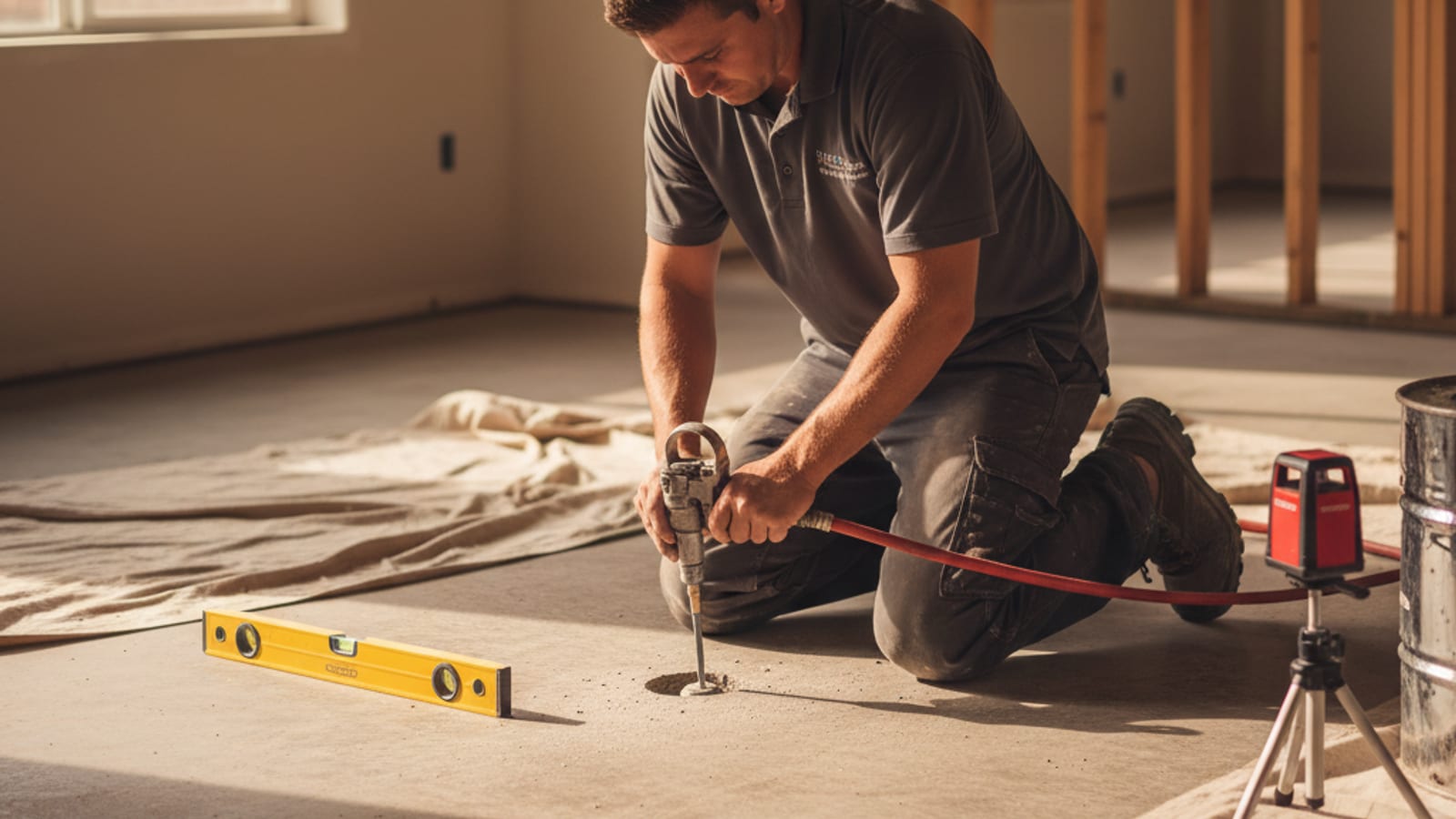
Step 4: Fill the voids. Polyurethane injection through small holes drilled in the slab. The expanding foam fills the void and lifts settled slab back into proper position. Cost: $8-$25 per square foot of affected area.
Step 5: Address structural settlement. If the slab perimeter footing has settled (not just the interior slab), helical pier underpinning at the affected area. Cost: $1,800-$3,500 per pier installed.
Step 6: Crack injection. Any structural cracks that opened during settlement get sealed with structural epoxy after the structure is stable. Cost: $400-$1,200 per crack.
Step 7: Cosmetic repair. Drywall patching, paint, tile reset where damaged. Usually $1,500-$5,000 in finish trades.
For a typical “discovered late” slab leak case in a 1,800 sq ft San Diego home, the full sequence runs $15,000-$45,000 depending on the extent of void and structural damage.
For an “early” case where the leak is found before significant settlement, just steps 1 and 2: under $5,000.
That difference, $5,000 vs. $40,000, is why early detection matters.
Insurance and slab leaks
This is where it gets nuanced. Standard California homeowner’s policies typically cover:
- The water damage caused by a sudden leak (water-soaked carpet, drywall, etc.)
- The cost of “tear-out and access” to find and reach the leak
- Sometimes the cost of repairing damaged personal property
They typically do not cover:
- The cost of repairing the leak itself (the plumbing repair)
- The cost of foundation repair caused by long-term leaking
- Mold remediation in some cases (depends on policy)
Document the discovery date, the plumber’s invoice with diagnosis, and any pre-existing symptoms (high water bills, etc.) carefully. The coverable angle is “sudden” damage; the more sudden the leak appears, the more likely the water damage portion is covered.
The foundation repair from long-term void formation is essentially never covered. We document the cause for your records but don’t promise coverage.
Prevention for older homes
If your home has copper supply lines that are 30+ years old, you’re in the slab leak risk window. Options:
- Annual leak detection check. Plumber listens at known supply line locations, checks meter, looks for symptoms. ~$200/year, peace of mind.
- Water shutoff with leak detection. Smart shutoff valves (Flo by Moen, Phyn) automatically detect abnormal flow and shut off the main. ~$600-$1,200 installed.
- Whole-home repipe. Replace the copper supply with PEX through walls and attics, abandoning the in-slab lines. The expensive option, but eliminates slab leak risk permanently. $8,000-$18,000 typical for a single-family home.
Most homeowners don’t repipe until the second slab leak. Once you’ve had one, the math on prevention changes.
What we do (and what we don’t)
We’re foundation contractors, not plumbers. The slab leak repair itself is plumber work; we coordinate but don’t do it.
Our scope on a slab leak case:
- Foundation inspection to determine extent of structural damage
- Void mapping and polyurethane injection
- Slab jacking to lift settled areas
- Helical pier underpinning if perimeter settlement has occurred
- Crack injection on any structural cracks
- Engineer coordination if permit work is needed
We work with several licensed plumbers across San Diego County and can recommend one if you don’t have one. The coordination is usually a phone call: plumber finds and fixes the leak, calls us to come look, we inspect and quote the foundation side.
If you suspect a slab leak, get the plumbing diagnosed first. Once you know the leak is real, call us for the foundation inspection, usually within a week or two of the plumbing repair, while the void is still fresh and the structural damage hasn’t progressed further.