Here’s the short answer: use epoxy on dry, dormant cracks where you need to restore structural strength; use polyurethane on wet, active, or leaking cracks where you need a flexible waterproof seal. Getting that wrong means the repair fails, sometimes quickly.
Crack injection is one of the most misunderstood repairs in foundation work. The technique sounds simple, inject material into a crack and seal it, but the two materials behave completely differently and suit different problems. If you’ve got a crack in a concrete wall or stem wall and you’re trying to decide what to do, this guide walks through how injection works, which product fits which crack, what it actually costs, and when injection alone isn’t enough.
How crack injection works
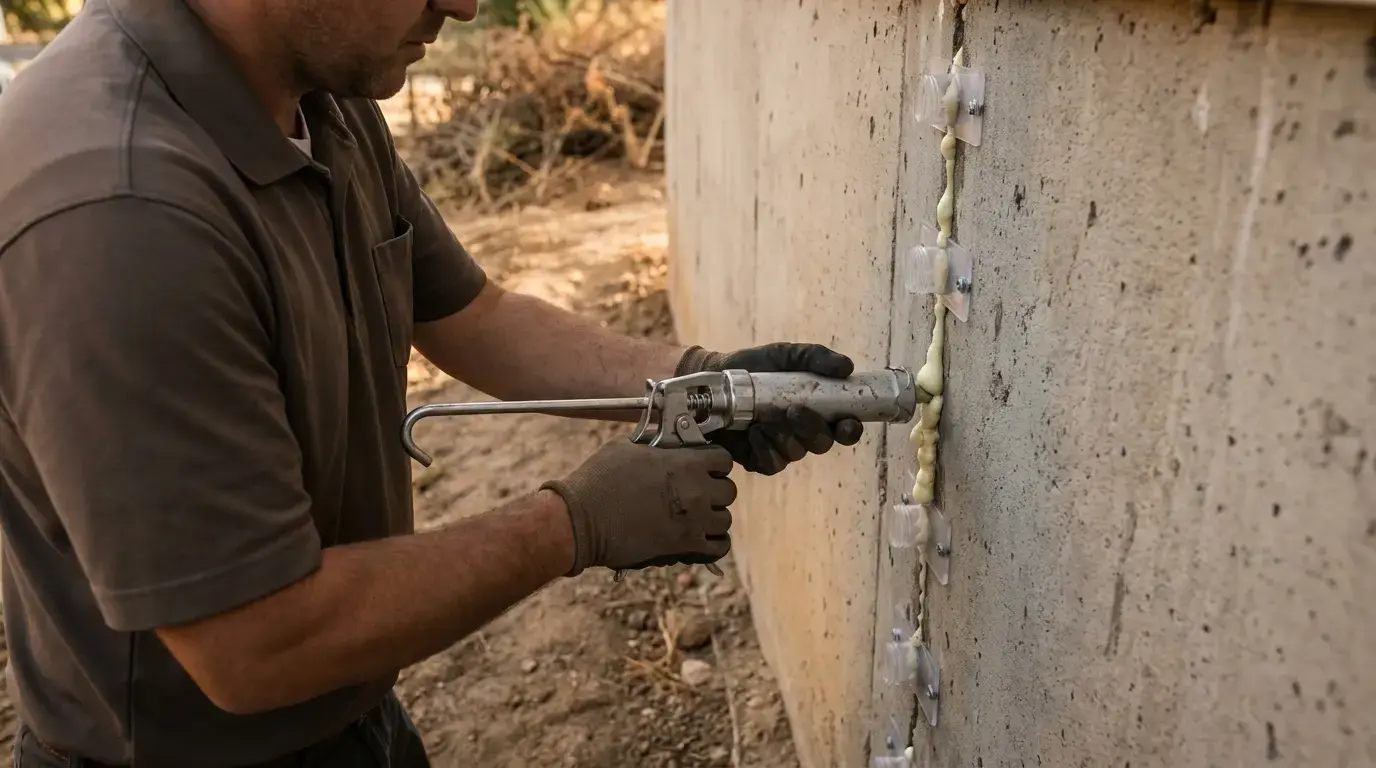
The process is the same whether you’re using epoxy or polyurethane. A technician drills or sets injection ports along the crack, typically every few inches, alternating sides. The surface of the crack gets sealed with a surface cap, usually an epoxy paste, so material doesn’t just blow back out. Then the chosen filler gets injected under low pressure through each port in sequence, moving from bottom to top on vertical cracks.
Done correctly, material flows through the crack and fills it from the inside out. You’ll often see it weep out of the next port up, which tells you the section below is fully filled. It takes patience. Rushing the pressure causes blowouts and gaps.
The crack still exists as a line in the concrete afterward. What injection does is bond or seal that line so it can’t transmit water or lose structural integrity.
Epoxy: the structural glue
Epoxy injection bonds concrete back together. When it cures, it’s rigid and harder than the concrete itself. A properly injected epoxy repair can restore a cracked wall to nearly its original load capacity.
That makes epoxy the right call for:
- Dry, dormant cracks that show no movement and no moisture
- Structural cracks in beams, columns, or load-bearing walls where restoring tensile strength matters
- Hairline to medium-width cracks (roughly 0.002 to 0.5 inches)
What epoxy can’t do is flex. Concrete moves seasonally, especially in San Diego where expansive clay soils shift with rain and drought cycles. If a crack is still active, meaning it opens and closes with temperature or soil moisture changes, a rigid epoxy repair will re-crack. You’ve bonded two pieces that still want to move independently, and something has to give.
Epoxy also won’t bond properly to wet concrete. Moisture at the crack face prevents adhesion. So if there’s active seepage, epoxy is the wrong material regardless of what else is going on.
Polyurethane: the flexible seal
Polyurethane foam is hydrophobic and flexible. It reacts with moisture, expanding to fill the crack and create a watertight seal. Polyurethane can be injected into a wet or actively leaking crack and still bond.
That makes it the right call for:
- Cracks with active water intrusion or seepage
- Cracks that show seasonal movement (opening and closing)
- Below-grade walls where ongoing soil moisture is a factor
- Situations where keeping water out matters more than restoring load capacity
The tradeoff: polyurethane doesn’t restore structural strength. It seals the crack but leaves the wall as two pieces bridged by flexible foam. If the crack is in a load-bearing location and structural integrity is the concern, polyurethane alone isn’t sufficient.
Comparison at a glance
| Epoxy | Polyurethane | |
|---|---|---|
| Primary purpose | Structural bonding | Waterproof sealing |
| Works on wet cracks | No | Yes |
| Handles active movement | No | Yes |
| Restores load capacity | Yes | No |
| Flexibility when cured | Rigid | Flexible |
| Best crack type | Dry, dormant | Wet, leaking, active |
| Typical pro cost per crack | $400 – $800 | $300 – $700 |
These ranges reflect single-crack repairs by a licensed contractor. Multiple cracks, difficult access, or additional waterproofing work will affect the final number.
The San Diego angle
San Diego’s expansive clay soil is worth understanding before you commit to a repair method. Clay swells when wet and shrinks when dry. That seasonal cycle puts lateral pressure on foundations and stem walls during wet winters, then pulls away during dry summers. The result is cracks that aren’t truly dormant, they’re just quieter in summer.
A crack that looks stable in September may open again after January rains. That’s why polyurethane is often the better choice for below-grade cracks on older San Diego homes, even when there’s no visible water at the time of repair. The flexibility accommodates what the soil is going to do anyway.
For more on the connection between soil movement and cracking, the foundation crack types guide covers how to read what a crack is telling you before you decide on a fix.
DIY kits vs. professional injection
DIY epoxy and polyurethane injection kits exist and some homeowners use them successfully on simple surface cracks. The materials are the same. What differs is equipment and technique.
Professional injection rigs maintain consistent low pressure and let the technician feel when a section is fully saturated. DIY kits are often cartridge-based and rely on manual pressure, which makes it easy to push too fast, leave voids, or pop a port loose. On a purely cosmetic hairline crack in a non-structural location, a DIY kit might be fine. On anything in a load-bearing wall, a below-grade wall with water pressure behind it, or a crack wider than a credit card, professional work is worth the cost.
A failed injection that gets re-cracked or re-leaks still needs to be addressed, sometimes with more work than the original repair would have taken.
When injection isn’t enough
This is the part that matters most. Foundation crack repair by injection works for cracks caused by concrete curing, minor settlement, or thermal movement. It does not fix the cause of structural settlement.
If a crack is wide, stepped, or offset, where one side of the crack sits higher or lower than the other, that’s a sign of differential settlement. The foundation isn’t just cracked, it’s moving. Injecting that crack seals the symptom while the underlying movement continues. The repair will fail, and the structural problem gets worse in the meantime.
Settlement cracks need foundation repair that addresses the soil and structural support, typically helical piers or push piers driven to stable bearing depth. Once the foundation is stabilized and movement has stopped, any remaining cracks can be addressed with injection if needed.
If you’re seeing signs of foundation problems alongside the cracks, things like sticking doors, sloped floors, or gaps at window frames, don’t assume injection alone is the answer. Those are settlement signals.
Keeping water out long term
Crack injection handles the crack itself, but it’s one part of a complete water management strategy. If you have below-grade walls taking on moisture, the source is often hydrostatic pressure from saturated soil, not just the crack opening. Foundation waterproofing addresses that broader picture, whether through interior drainage, exterior membrane systems, or improved grading.
The foundation waterproofing guide covers how these systems layer together. A sealed crack in a wall that still faces unchecked hydrostatic pressure may hold for a season, but eventually the water finds the path of least resistance.
Getting an accurate read on your crack
The right material and the right repair depend on understanding what’s actually happening at your foundation. Crack width, location, activity, moisture, and any signs of movement all factor in. A crack that looks simple from the surface can tell a different story once someone gets eyes on the full wall.
If you’ve got a crack you’re trying to figure out, a foundation inspection puts a trained eye on it and gives you a straight answer on what it is, what’s causing it, and what the fix actually needs to be.
Base Pro San Diego offers free crack evaluations throughout San Diego County. Call (858) 925-5546 or reach out online to set one up. You’ll know what you’re dealing with before spending a dollar on any repair.