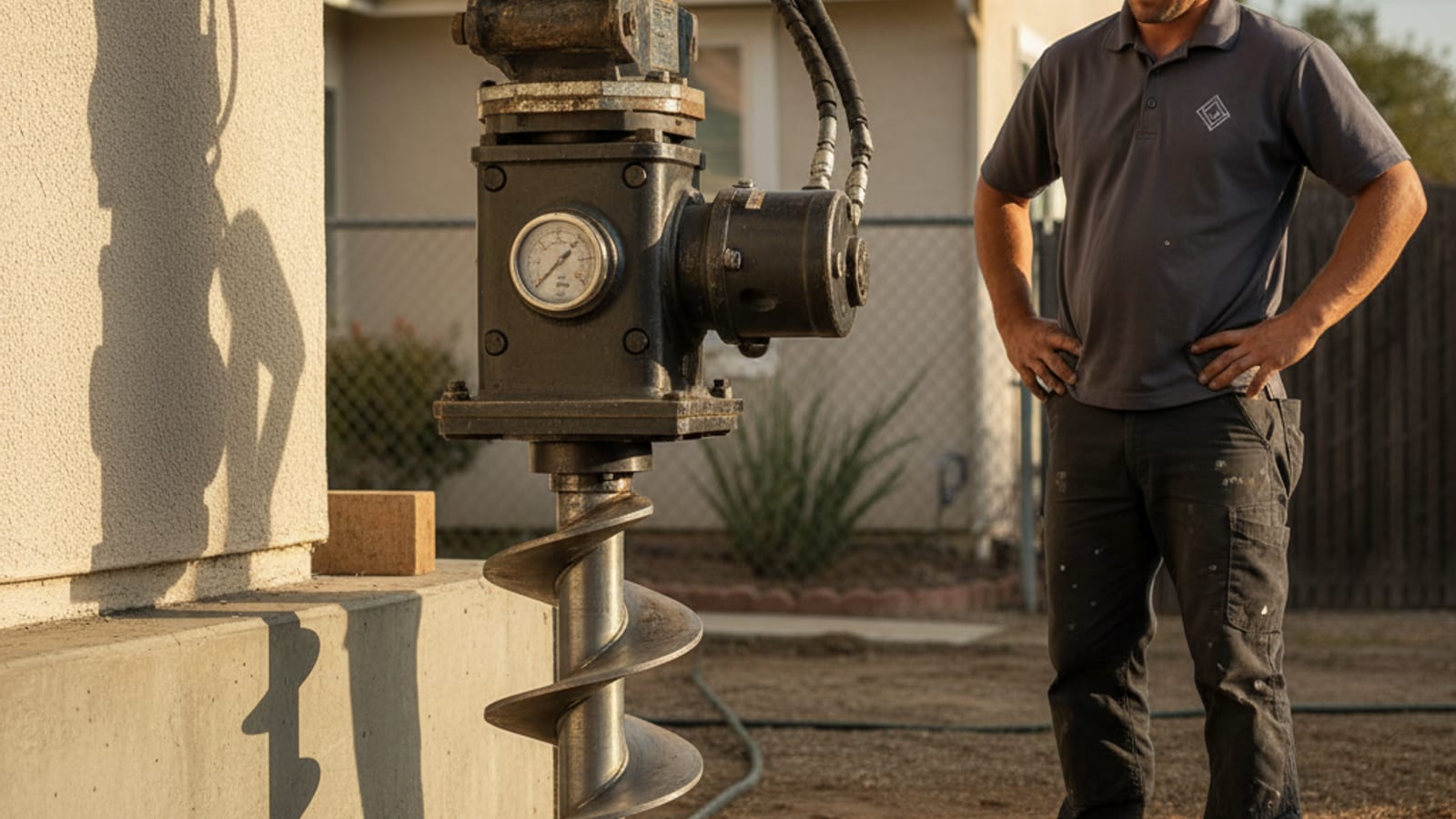
Helical piers in San Diego County run $1,800 to $3,500 per pier installed in 2026. Most settled corners need 4 to 8 piers, so a partial repair lands around $8,000 to $18,000. Full perimeter underpinning on a typical 1,800 square foot home takes 12 to 20 piers and runs $25,000 to $50,000. The number of piers is the biggest cost driver, and that number is set by your soil, your home’s weight, and how far the house has already moved.
Here’s the full picture for San Diego, with the local factors that national price guides skip.
Helical pier cost in San Diego, at a glance
National cost articles quote a per-pier number and stop there. That number is real, but it’s only half the answer. What you actually pay depends on pier count and pier depth, and both of those swing hard in San Diego County because of how varied our ground is.
| What you’re paying for | San Diego range (2026) |
|---|---|
| Single helical pier, installed | $1,800 to $3,500 |
| Partial corner repair (4 to 8 piers) | $8,000 to $18,000 |
| Full perimeter, ~1,800 sq ft home (12 to 20 piers) | $25,000 to $50,000 |
| Engineering and stamped plan | $1,500 to $5,000 |
| Geotechnical soils report (if required) | $1,500 to $4,500 |
| Permit fees (varies by jurisdiction) | $300 to $2,000+ |
These are working ranges, not a quote. The only honest number is the one that comes after an inspection and a level survey. We’ll get to that.
Why per-pier price isn’t the whole story
A helical pier is a steel shaft with welded plates that gets screwed into the ground until it hits soil strong enough to carry the house. Two things decide the total: how many piers, and how deep each one goes.
In San Diego that depth ranges wildly. In inland canyons with decomposed granite over bedrock, a pier might reach capacity at 8 feet. Near old creek beds and in deep alluvial fill, the same pier can run 35 feet or more before it finds bearing. Deeper means more shaft sections, more drive time, and a higher cost per pier. A contractor who quotes a flat per-pier rate without seeing your soil is guessing.
Pier count comes from the structural engineer’s plan, not from a rule of thumb. The plan reads the soil profile, the structure load, and the movement, then specifies exactly how many piers and where. A good contractor bids that plan line by line.
What drives the price up or down in San Diego
Expansive clay soil. Much of San Diego County sits on clay that swells when wet and shrinks when dry. That seasonal heave and settlement is the reason a lot of homes need piers in the first place, and it’s why depths run deeper here than in stable inland markets. Our guide to expansive clay soils in San Diego breaks down which neighborhoods sit on it.
Hillside and fill lots. A flat lot with truck access at every pier location is the cheapest case. A hillside backyard reachable only through the garage adds real labor. Homes built on engineered fill, common across our canyon-and-mesa terrain, often need deeper piers to reach native soil.
Seismic considerations. San Diego sits near active fault zones. Engineering for an underpinning plan accounts for lateral loads, which can change pier spec and spacing. That’s a cost factor national guides never mention because they’re written for the whole country.
Structure type. Two-story homes, masonry construction, and heavier loads call for more piers or push piers instead. If helical can’t reach the engineered capacity your home needs, the engineer may switch the spec. We explain the tradeoff in helical piers vs. push piers.
Permit and engineering. Any pier install in San Diego County needs a permit and an engineer’s stamped plan. Engineering runs $1,500 to $5,000. Jobs above roughly six piers often trigger a geotechnical soils report in most local jurisdictions. The pros we send pull the permit and quote it as a line item, never marked up.
Access and concurrent work. If we’re already onsite, adding drainage retrofit or crack injection costs less than booking each separately. The cause and the symptom usually need addressing together, so most plans bundle them.
How San Diego compares to national averages
National price guides put helical piers around $1,500 to $3,000 per pier and full projects around $10,000 to $25,000. San Diego runs at the higher end of those ranges, and full-perimeter jobs often exceed them. Three reasons: deeper average pier depths in our clay and fill, higher engineering and permit costs in California, and seismic design requirements. A $12,000 national-average project can land at $18,000 to $25,000 here for the same scope. That’s not a markup. It’s the ground.
Will insurance pay for it?
Usually no. Standard California homeowner’s policies exclude soil movement, settlement, and earth movement, even when a plumbing leak caused it. The exception is sudden damage from a covered peril, like a vehicle hitting the home or a water main break. If a slab leak created the void, the leak repair and some resulting water damage may be covered, but the pier work almost never is. Document the cause carefully so your adjuster has what they need.
What to ask before you sign
A few questions separate a transparent bid from a guess:
- “Can I see the engineer’s stamped plan?” If there isn’t one, the price is a guess and the permit will stall.
- “What’s the per-pier price, and how many piers does the plan call for?” If you can’t get both numbers, the math isn’t transparent.
- “What warranty comes with the piers?” Ask what’s covered, for how long, and whether it transfers when you sell. Get it in writing.
- “Will you pull the permit?” If they say no, walk away. Unpermitted underpinning fails buyer inspections.
- “How will you address the cause?” If the answer is just “install piers,” you may repair this house twice.
For the rest of the bid-vetting process, see our foundation repair cost guide for San Diego.
Frequently asked questions
How many helical piers will my house need? It depends on how much of the foundation has settled and how heavy the structure is. A single dropped corner might need 4. Full perimeter underpinning on an 1,800 square foot home runs 12 to 20. The engineer’s plan sets the exact count after a soil review.
Why are helical piers more expensive in San Diego than the national average? Deeper average pier depths in our expansive clay and fill, higher California engineering and permit costs, and seismic design requirements all push the local number above national price guides.
How deep do helical piers go in San Diego County? Anywhere from 8 feet over shallow bedrock in inland canyons to 35 feet or more in deep clay and alluvial fill near old creek beds. Deeper piers cost more because they take more shaft sections and more drive time.
Are helical piers permanent? Yes. Steel helical piers transfer the home’s weight to stable soil below the active zone, so they’re a long-term fix when installed to an engineered plan. Ask your contractor what warranty backs the install.
Do I need a permit for helical piers in San Diego? Yes. Every pier install in San Diego County requires a permit and a stamped engineering plan. Larger jobs often need a geotechnical soils report too. A contractor who skips the permit is setting you up to fail a future home inspection.
Helical piers or push piers, which is cheaper? Helical piers usually cost a bit less per pier. Push piers run higher and get used for two-story homes, masonry, and cases where helical can’t reach the needed capacity. The engineer picks based on your soil and load, not price alone.
Get a straight number for your home
Every helical pier quote we give starts with a free onsite inspection. We run a level survey, map the cracks, document everything with photos, and walk you through what we see. You get an upfront price before any work starts. No hourly billing, no surprise change orders.
If your floors are sloping or a corner is dropping, call Base Pro San Diego at (858) 925-5546. We cover all of San Diego County, and the inspection is free. You can also learn more about our helical pier installation service.