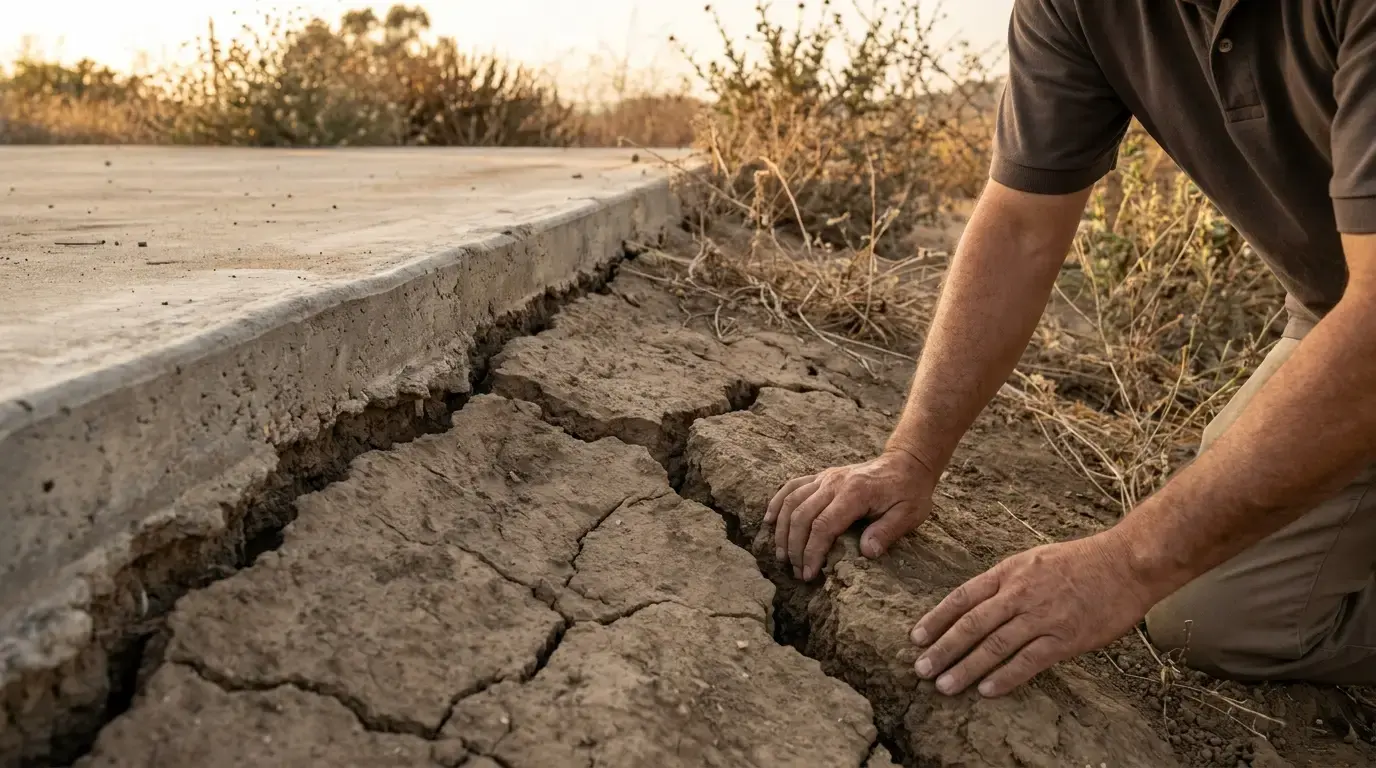
Settlement drops a foundation down. Heave pushes it up. Both cause cracks, sloping floors, and sticking doors, but they need completely different fixes. Confuse the two and you’ll spend money on a repair that does nothing, or worse, makes things worse.
Here’s how to tell them apart, why San Diego’s clay soil makes both surprisingly common, and what the right correction looks like for each.
The core difference
Settlement happens when the soil beneath a foundation compresses, washes out, or shifts downward. The ground loses its ability to hold the weight above it, and the foundation drops, sometimes evenly, often in one corner or along one side.
Heave is the opposite. Expansive clay soil absorbs water and swells, pushing the foundation upward. The ground isn’t failing to support weight; it’s actively lifting the structure.
Both can crack the same wall, slope the same floor, and jam the same door. That similarity is exactly why misdiagnosis is so common.
Why San Diego is especially complicated
San Diego sits on some of the most expansive clay soils in California. When that clay dries out in summer, it shrinks and pulls away from the foundation. When winter rains arrive, it absorbs water and swells back up.
That seasonal cycle means a slab can behave differently depending on the time of year. A foundation that drops slightly during a dry summer might lift a little after the first heavy rains. If you only measure once, you might get a misleading picture of what’s actually happening.
This is one reason expansive clay soils in San Diego deserve their own attention. It’s not just a generic “bad soil” problem. The clay here is particularly reactive, and homes built on cut-and-fill lots face the added challenge of having engineered fill on one side and native soil on the other, which can move at different rates.
Heave vs. settlement: a side-by-side look
| Settlement | Heave | |
|---|---|---|
| Cause | Soil compresses, washes out, or can’t bear the load | Expansive clay absorbs water and swells |
| Direction | Foundation drops downward | Foundation pushes upward |
| Common signs | Cracks widening at the top, floors that slope toward an outer wall, gaps under door frames | Cracks widening at the bottom, floors that hump or bow upward, interior slab lifting |
| Timing | Often gradual and progressive | Can be seasonal or follow irrigation/rain events |
| Right fix | Piers, underpinning, foundation repair | Moisture control, drainage systems, sometimes soil removal |
How to read the signs
The pattern and location of cracks tell you a lot. Settlement typically opens cracks wider at the top, because the wall is dropping and pulling apart above the point of movement. Heave tends to open cracks wider at the bottom, because the soil is pushing up and rotating the wall or slab.
Where the movement is concentrated matters too. Perimeter settlement often shows up at corners, especially where downspouts dump water or where tree roots have pulled moisture from the soil. Interior heave is common under slabs in the center of a home, particularly in laundry rooms or bathrooms where water usage is high and a small leak can quietly saturate the clay below.
Doors are useful clues. If the same door sticks in winter but swings freely in summer, that’s a sign of seasonal movement. Consistent sticking that gets worse over time regardless of the season is more likely progressive settlement.
Floors tell you the direction. A floor that slopes toward an exterior wall is dropping. A floor that develops a hump or high spot in the middle is lifting. Walk the slab carefully and notice where the highest point is.
Why the diagnosis changes the repair
This is where the stakes are real. Foundation repair with piers is designed to address settlement. Piers are driven down through the problem soil and anchored in stable load-bearing material below. They lift the settled section back toward its original position and hold it there.
Piers do nothing for heave. If expansive clay is pushing your slab up, driving piers doesn’t fix that. The soil is still going to swell when it gets wet. You need to address why the soil is getting wet and staying wet.
Soil stabilization approaches heave differently. The goal is to manage moisture in the soil, either by improving drainage so water moves away from the foundation, by adjusting irrigation habits so the clay isn’t getting repeatedly saturated and dried, or in some cases by removing the most reactive soil and replacing it with material that doesn’t swell.
If drainage around the house is directing water toward the foundation, that’s often the starting point. No repair holds up if the underlying moisture problem isn’t corrected first.
The role of irrigation and watering habits
This comes up constantly in San Diego. Many homeowners water their landscaping right along the foundation line, which keeps the clay near the perimeter perpetually moist. The clay swells, then they wonder why the slab near the front garden is lifting.
Conversely, homeowners who stop watering during dry stretches sometimes create a situation where the clay shrinks dramatically on one side of the house, causing differential settlement where the side near the dried-out soil drops more than the irrigated side.
Consistent moisture is kinder to clay soil than wet-dry cycles. That doesn’t mean watering more; it means keeping conditions as even as possible and directing water away from the foundation rather than pooling it nearby.
How pros distinguish them
A level survey is the most reliable tool. A contractor measures multiple points across the slab and around the perimeter, then compares those measurements over time. A single reading tells you where things are now. Readings taken months apart, ideally across different seasons, show you which direction things are moving and how fast.
Soil knowledge matters too. If a contractor knows what type of soil sits beneath your foundation and whether it’s fill or native material, that context shapes the interpretation. A point that reads high in March and low in August is behaving seasonally. A point that keeps dropping every time it’s measured is settling progressively.
Sometimes both processes are happening on the same property. Settlement in one corner, heave in another. That’s more common than most homeowners expect, and it’s exactly why a site-specific foundation inspection beats any checklist approach.
What to do if you’re not sure
If you’re seeing cracks, sloping floors, or doors that behave differently than they used to, start by noting the details. When did it start? Does it change with the seasons? Where are the cracks widest and in which direction do they open?
Then get a professional assessment before assuming the cause. The crack types and what they mean post covers common patterns in more depth. And if your soil hasn’t been evaluated, soil stabilization options are worth understanding before committing to any repair.
At Base Pro San Diego, we start every job with a diagnostic inspection because a repair built on the wrong diagnosis is just a delay. If you’re in San Diego County and want a clear answer on what’s happening under your home, call us at (858) 925-5546. We’ll take a look, give you an honest read, and tell you exactly what you’re dealing with before recommending anything.