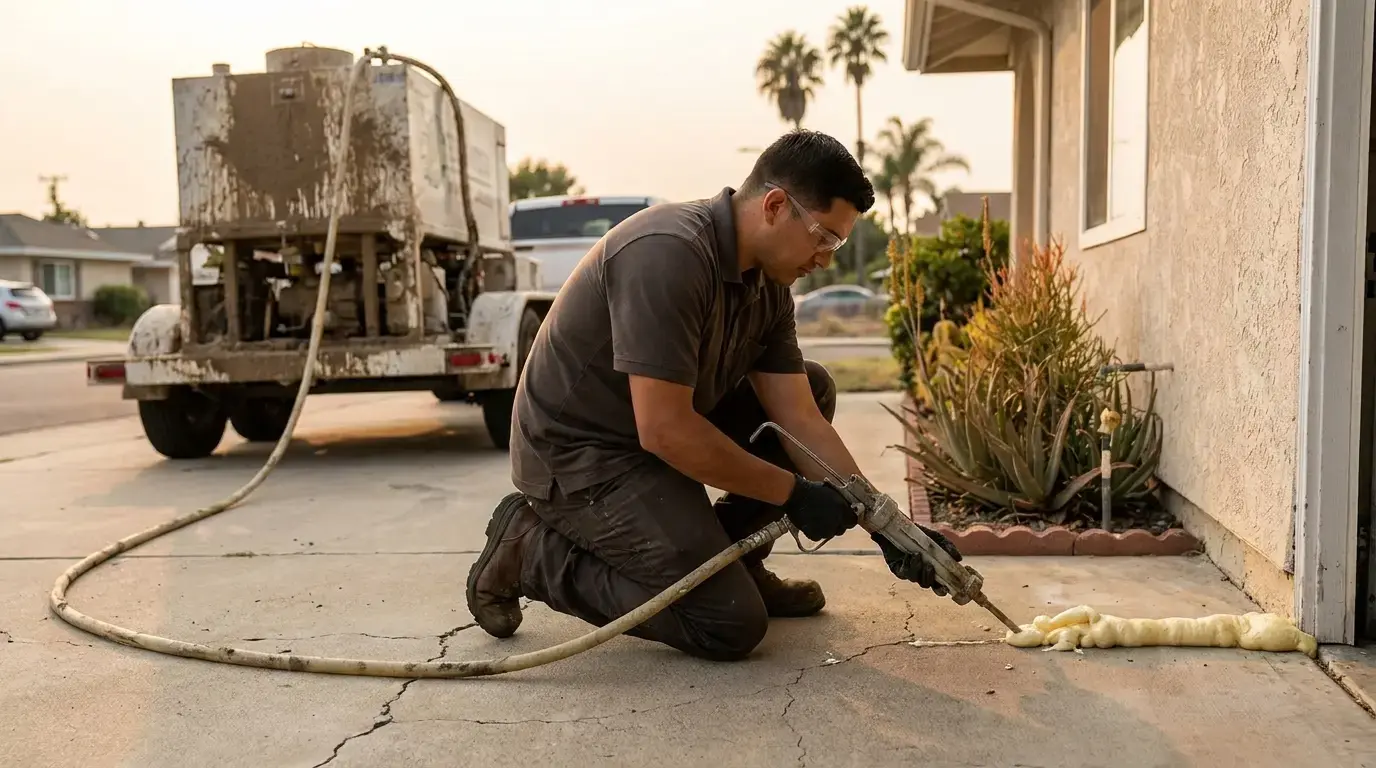
If you’ve got a sunken driveway, a tilted patio slab, or a garage floor that slopes toward a wall, concrete slab leveling can fix it without tearing out and replacing the concrete. Two methods dominate the market: mudjacking and polyurethane foam injection. Both lift settled slabs. They work differently, cost differently, and fit different situations.
Here’s the quick take: foam is faster, lighter, and better for most San Diego residential jobs. Mudjacking is cheaper per square foot and fine for heavy-load slabs where the extra weight doesn’t matter. The right answer depends on what’s under your slab.
What slab leveling actually does
Slab leveling lifts concrete that has settled unevenly. When the soil beneath a slab compresses, washes out, or shrinks, part of the slab drops and the rest stays put. You end up with a tripping hazard, drainage problems, or gaps where water pools.
Common candidates for leveling:
- Driveways with a section that dropped an inch or two
- Patio slabs that tilt toward the house
- Sidewalks and walkways with raised or sunken panels
- Garage floors that sloped over time
- Interior concrete slabs in older homes or additions
The process involves drilling small holes through the slab, injecting material underneath to fill the void, and then plugging the holes. The slab rises back toward its original position.
What it does not do: fix the reason the slab settled in the first place. If shrinking clay soil, a plumbing leak, or poor drainage caused the void, those issues need attention or the slab will settle again. A good contractor will tell you this upfront. If yours doesn’t, that’s a red flag.
How mudjacking works
Mudjacking has been around for decades. The crew drills holes roughly 1.5 to 2 inches in diameter through the slab, then pumps a slurry of cement, soil, and water through those holes under pressure. The slurry fills the void and hydraulically lifts the slab. Once it’s level, the holes get patched.
The material is relatively heavy. That added weight goes back into soil that already compressed once, which is worth thinking about on softer ground. Cure time is typically 24 to 48 hours before you can drive or walk on it.
Cost runs roughly $3 to $7 per square foot, depending on slab thickness, how far it needs to lift, and accessibility. A small sunken section of a driveway might be a few hundred dollars. A larger job can run into the low thousands.
How polyurethane foam injection works
Foam lifting uses two-part expanding polyurethane resin. The crew drills smaller holes, usually around 5/8 inch, injects the foam through a port, and the material expands to fill voids and lift the slab. It cures in minutes.
The foam is lightweight, which puts almost no additional load on the soil. It’s also water-resistant, so it won’t wash away if the area sees moisture again. Because the holes are smaller and the material cures fast, you can use the surface the same day.
Cost is higher: typically $8 to $25 per square foot depending on the extent of the void, the number of injection points, and the contractor. The material itself costs more than slurry, which is what drives the price gap.
Side-by-side comparison
| Factor | Mudjacking | Polyurethane foam |
|---|---|---|
| Hole size | 1.5 to 2 inches | ~5/8 inch |
| Cure time | 24 to 48 hours | 15 to 30 minutes |
| Weight added | Significant | Minimal |
| Cost per sq ft | ~$3 to $7 | ~$8 to $25 |
| Longevity | 5 to 10 years typical | 10 to 20 years typical |
| Mess level | Moderate | Low |
| Void-fill precision | Good | Excellent |
Neither method is new. Both have a long track record when used in the right situation.
When to choose mudjacking
Mudjacking makes sense when:
- The slab is thick and heavy (commercial applications, heavy-load areas)
- Budget is the primary constraint and you’re okay with larger patch holes
- The soil beneath is stable and not prone to further movement
- You don’t need to use the surface for a day or two
It’s a proven method. In the right conditions it holds up well and costs less upfront.
When to choose polyurethane foam
Foam lifting is usually the better call for San Diego residential slabs because:
- San Diego soil is often expansive clay that shrinks and swells with seasonal moisture. Adding more weight with mudjacking slurry can accelerate re-settlement on clay-heavy lots.
- The smaller holes are less visible after patching, which matters on decorative concrete or near finished landscaping.
- Same-day return to service is a real advantage on driveways and walkways.
- The foam’s water resistance is a meaningful benefit in areas prone to irrigation runoff or grading issues.
For most sunken driveways, patios, and garage slabs in San Diego, foam injection is worth the higher upfront cost.
The San Diego soil angle
This is worth understanding before you hire anyone.
Much of San Diego County sits on expansive clay soils. These soils swell when wet and shrink when dry. That seasonal movement is one of the leading causes of settled slabs here. Del Cerro, Allied Gardens, El Cajon, Santee, and inland communities see this regularly.
Coastal and hillside areas have a different problem: sandy or decomposed granite soils that can wash out under slabs, especially with improper drainage or aging irrigation lines. A void forms, the slab loses support, and it drops.
Slab leaks are another San Diego-specific concern. A pressurized water line running under a concrete slab that develops a slow leak will erode soil over months or years and create significant voids. If you’re seeing a sunken interior slab or unexplained moisture, rule out a slab leak before spending money on lifting.
For soil stabilization under a chronically settling slab, lifting alone may not be enough. Addressing the underlying soil condition often matters more than which lifting method you pick.
What slab leveling won’t fix
Set realistic expectations before you commit.
Slab leveling works on concrete that has dropped due to void formation beneath it. It doesn’t repair cracked concrete beyond closing minor cracks as the slab rises. It doesn’t fix structural foundation problems. And it doesn’t address the cause of the settlement.
If your interior floors slope, your doors stick, or you’re seeing wall cracks alongside a sunken slab, the problem may not be the slab itself. It may be foundation movement that needs foundation repair or house leveling with piers rather than a surface-level lift. Injecting foam under a slab sitting on a failing foundation doesn’t address what’s actually happening.
A proper evaluation looks at the slab, the soil, the structure, and any signs of ongoing movement before recommending a fix. Anyone who quotes a job in five minutes without checking those things is guessing.
What a slab evaluation covers
Before any leveling work starts, a technician should:
- Measure the elevation across the slab to quantify the drop
- Check for voids using probing or ground-penetrating radar on larger jobs
- Assess crack patterns and determine if they’re cosmetic or structural
- Look at drainage, grading, and irrigation near the slab
- Rule out active slab leaks on interior slabs
This gives you a clear picture of whether leveling alone will solve it or whether slab repair or deeper foundation work is part of the answer.
If you’re comparing costs with full replacement, leveling typically comes in at 30 to 50 percent of what a tear-out and pour would cost, and it’s faster. But if the concrete is severely cracked, spalling, or too thin to lift without breaking, replacement may be the smarter long-term call.
Get a free slab evaluation
If you’ve got a settled slab in San Diego County, Base Pro San Diego offers free evaluations. We’ll look at the slab, check for underlying issues, and give you a straight answer on whether mudjacking, foam injection, or something else is the right move.
Call Base Pro San Diego at (858) 925-5546 or fill out the contact form. We’re straightforward about what the slab needs and what it doesn’t.
For more context on related costs and repairs, see our posts on house leveling costs in San Diego and slab foundation repair options.