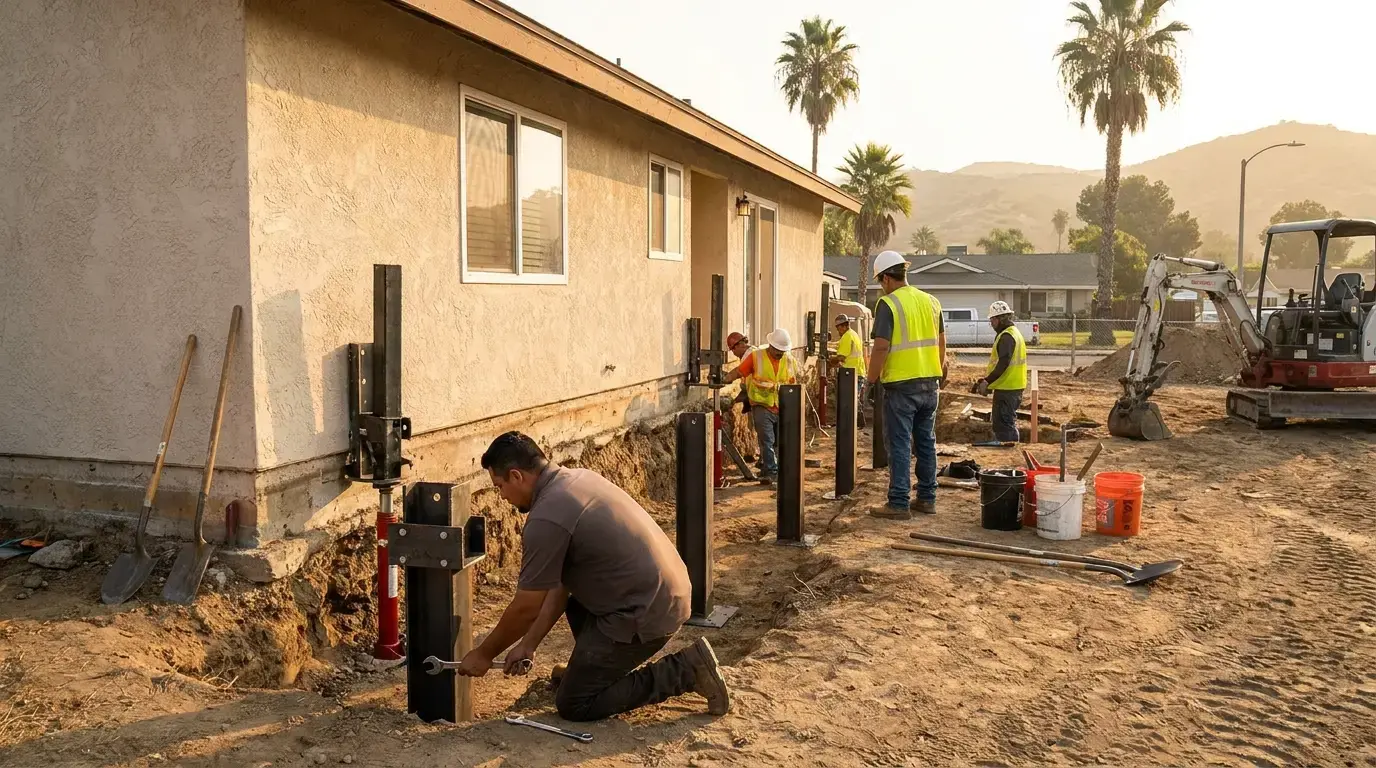
The actual install is often 1 to 5 days. But from your first call to the day the crew packs up and leaves, the full process typically runs 3 to 8 weeks. Most of that time is permits and engineering, not construction. Once the crew is on site, things move fast.
Here’s what that timeline looks like, phase by phase, and what pushes it longer or gets it done sooner.
Phase by phase: the full timeline
| Phase | Typical duration |
|---|---|
| Inspection and level survey | 1 to 2 days |
| Engineering and stamped plan | 1 to 3 weeks |
| Permit review and approval | 1 to 3 weeks |
| Scheduling and crew mobilization | 3 to 7 days |
| Installation | 1 to 5 days |
| Cleanup and final inspection | 1 to 3 days |
| Total, start to finish | 3 to 8 weeks |
Minor repairs, like crack injection or a single-corner stabilization that doesn’t require a permit, can be done in a day or two. Complex jobs on hillside lots with deep soils and structural engineering can run longer. The table above covers the typical mid-range project.
Phase 1: inspection and level survey
A foundation inspection usually takes one to two hours on site. The inspector walks the perimeter, checks interior floors for slope, photographs cracks, and pulls a level survey across the floor plan to map where the structure has settled and by how much.
You’ll get a written report and a repair recommendation within a day or two of that visit. That report is also the starting point for the engineering phase, so a thorough inspection matters. If you want to understand what goes into that inspection before you book one, the foundation inspection checklist breaks it down step by step.
Phase 2: engineering and stamped plan
Most foundation repair projects in San Diego require a stamped plan from a licensed structural engineer before the city will issue a permit. That plan specifies pier placement, load calculations, and installation method.
Engineering typically takes one to three weeks. Some engineers turn around simpler plans in a week. If your project involves a hillside, a retaining wall, or significant structural damage, expect the longer end of that range. This phase isn’t something to rush. A good stamped plan protects you during the permit process and gives the crew a clear scope to work from.
Phase 3: permit review and approval
San Diego’s building department processes foundation repair permits in roughly one to three weeks for most residential projects. Complexity affects review time. Hillside or coastal overlay zones, HOA review requirements, and larger pier counts can add time.
One thing homeowners sometimes don’t realize: the permit process is happening in parallel with scheduling, not before it. Most contractors will put you on the schedule once the permit application is submitted, so you’re not losing weeks waiting to get started.
Phase 4: scheduling and crew mobilization
Once the permit is approved, most contractors can mobilize within a week. During busy seasons, typically spring and fall in San Diego, it may run a few days longer. Your contractor should give you a firm start date when permits are in hand.
Phase 5: the installation itself
For a typical helical or push pier job, the install runs one to five days on site. A small corner repair with four to six piers can be done in a day. A full perimeter job with 20 or more piers may take three to five days. The crew works section by section, driving piers to the load-bearing stratum, attaching brackets, and then carefully lifting the structure back toward level.
If you want to understand how different pier types compare in terms of cost, timing, and application, helical vs. push piers covers that in detail. And the helical piers service page explains how that specific method works for San Diego soil conditions.
Crack repairs work differently. Foundation crack repair by injection, where epoxy or polyurethane is pumped into the crack, is often a same-day job with no permit required. The crew sets up, injects, and cleans up in a few hours.
Phase 6: cleanup and final inspection
After installation, the crew backfills excavated areas, removes equipment, and restores landscaping as close to original as practical. That typically takes one day.
The final inspection by the building department usually happens within a day or two of the contractor requesting it. Once the inspector signs off, your permit is closed and the job is officially complete.
What makes a job take longer
Several factors push timelines out. If your home sits on a hillside or has limited access, the crew may need equipment you don’t see on flat lots. Longer setup and careful rigging add time.
Deep soils, which are common in parts of San Diego County, mean piers have to travel further before hitting load-bearing ground. More depth means more time per pier.
High pier counts push the install itself from two or three days into four or five. HOA review adds a separate approval layer before the city permit can even be submitted. And if your soil report reveals unexpected conditions during the job, the engineer may need to revise the plan before work continues.
For more context on what drives cost alongside timeline, foundation repair cost in San Diego covers both in detail.
What makes a job go faster
Simple repairs move fast. A single-corner settlement with a handful of piers, clean access, and no structural surprises can go from inspection to complete in under two weeks. Crack injection jobs often wrap up in a single visit.
No permit required is a significant time-saver. Minor repairs that fall below the permit threshold skip the engineering and review phases entirely. Your inspector can tell you upfront whether your repair will need a permit.
Experienced crews also move faster because they’ve seen San Diego’s soil conditions many times. They anticipate what’s coming, and that keeps the job on schedule.
Do you have to move out?
In almost all cases, no. Foundation repair is done from the exterior and crawlspace. Your family continues living in the home throughout the project. The crew may need access to certain areas of the house for measurements or to confirm lift, but day-to-day life isn’t significantly disrupted.
There may be noise during installation hours, typically 7 a.m. to 5 p.m. on weekdays, and some vibration in the floor during pier driving. That’s normal and temporary.
Getting a real timeline for your home
The only way to know your actual timeline is to get a site-specific inspection. Every home is different. Soil conditions, access, pier count, and permit requirements all vary by property.
If your home is showing signs of settlement, read through the foundation settlement repair overview to understand what the repair process involves before you call.
Base Pro San Diego offers free inspections with a written report and a realistic project timeline. Call us at (858) 925-5546 to schedule yours. We’ll walk you through what’s needed, how long it will take, and what to expect from start to finish.