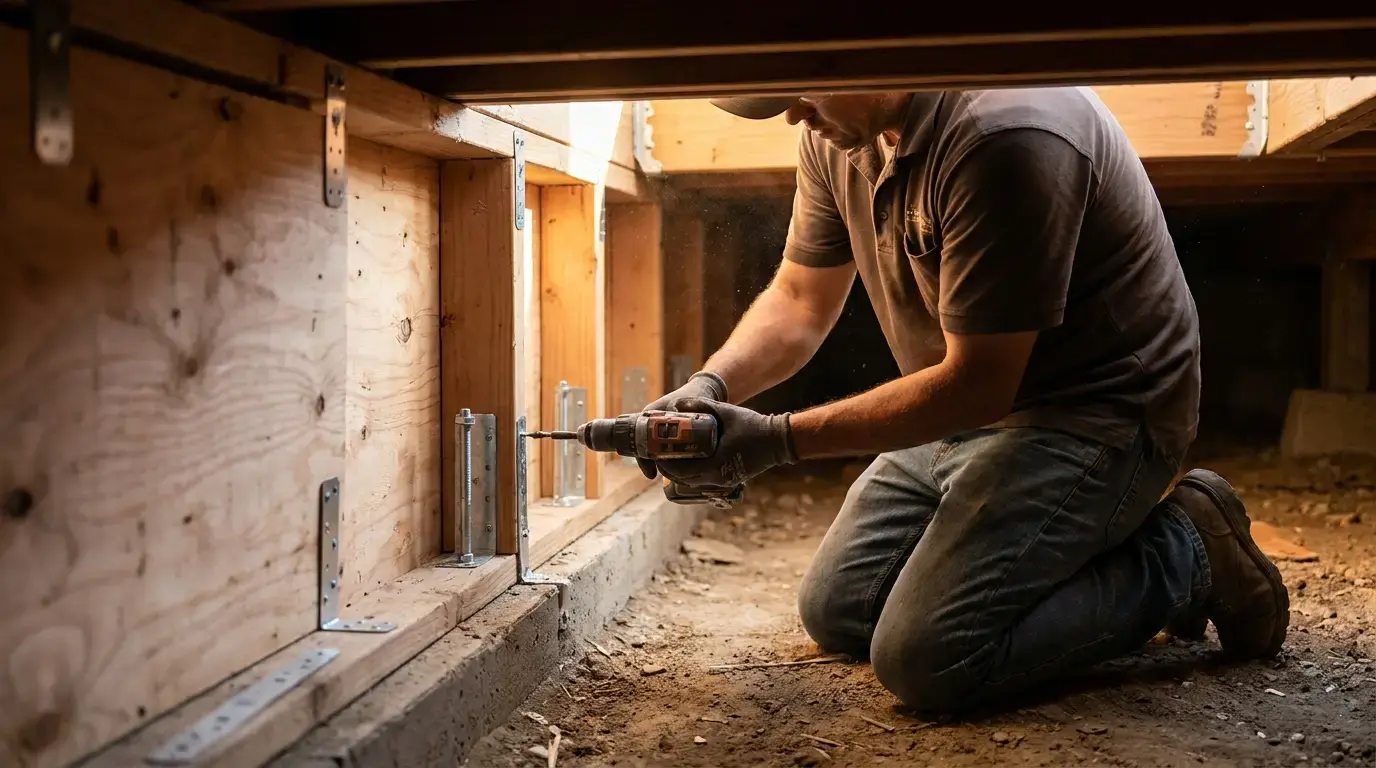
If your San Diego home has a raised foundation and was built before 1980, there’s a decent chance it could slide off its foundation in a significant earthquake. The fix is called a seismic retrofit, and most homes can be made substantially safer for $3,000 to $10,000. That’s a reasonable number when you consider that an unretrofitted house can shift completely off its stem walls in a major event, turning a livable structure into a total loss.
San Diego isn’t Los Angeles, and we’re not the Bay Area. But the Rose Canyon fault runs right through the city, and a Northridge-scale event here is a realistic scenario. Older raised-foundation homes are the most exposed. Here’s what you need to know.
What a cripple wall actually is
A cripple wall is the short wood-framed wall that sits between your concrete stem wall (the foundation perimeter) and the floor system of your house. It’s usually 12 to 48 inches tall, depending on how much clearance the builder wanted under the floor.
The name sounds alarming, but it just means “short wall” in construction terms. Cripple walls were standard practice for decades. The problem is that without bracing, they act like a hinge point during an earthquake. The ground shakes, the concrete foundation stays put, and the wood frame above it can rack sideways and collapse. The house doesn’t fall through the foundation. It falls off it.
Homes built before 1980 were generally not required to have any cripple wall bracing. Many older homes in North Park, South Park, Kensington, La Mesa, and similar neighborhoods with craftsman and bungalow stock sit on exactly this kind of unbraced frame.
What a seismic retrofit involves
A basic retrofit addresses two failure points: the connection between the sill plate and the foundation, and the lateral stability of the cripple walls.
| Retrofit component | What it does |
|---|---|
| Anchor bolts | Bolt the sill plate (bottom wood piece) directly to the concrete stem wall so the house can’t slide off |
| Steel plate washers | Spread the load at each bolt so the wood doesn’t split under stress |
| Plywood sheathing | Applied to the inside face of the cripple wall panels to resist racking forces |
| Hold-down hardware | Heavy metal connectors at corners and high-stress points that tie the framing together |
| Blocking | Added between joists at the top of the cripple wall to transfer loads properly |
The work happens almost entirely in the crawl space. A contractor cuts into the foundation at intervals to install new anchor bolts, then nails structural plywood to the cripple wall framing. The job typically takes one to three days depending on the size of the house and how accessible the crawl space is.
You can learn more about crawl space conditions and repair in detail, since the retrofit work happens in the same space and the two projects often overlap.
Which San Diego homes need it most
Raised-foundation homes built before 1979 are the primary candidates. The 1979 building code update began addressing seismic connections, and the 1994 Northridge earthquake prompted another round of code upgrades that affect homes built after that point.
If your home was built before 1979 and has a crawl space rather than a slab, it’s worth having someone look at it. The specific risk factors that push a home higher on the priority list:
- Cripple walls taller than 14 inches (they rack more easily)
- Soft or sandy soil that amplifies ground motion
- Hillside location where the foundation height varies
- Any existing foundation damage, settling, or wood rot
That last point matters a lot. A retrofit bolts the house to the foundation, but if the foundation itself is cracked, settled, or the sill plate has rot, you’re anchoring to a compromised base. This is why foundation condition has to be assessed before or alongside retrofit work. A foundation inspection can clarify whether you’re dealing with a retrofit-only situation or whether foundation repair needs to happen first.
Our post on signs of foundation problems covers what to look for before you call anyone.
The Rose Canyon fault and San Diego’s real seismic picture
People sometimes assume San Diego is low-risk because it’s not the Bay Area. That’s partly true and partly wishful thinking.
California’s statewide seismic hazard maps show San Diego in a moderate-to-high zone. The Rose Canyon fault passes through central San Diego and extends offshore. Geologists believe it’s capable of producing a magnitude 6.5 to 7.0 earthquake. That’s not a catastrophic scenario on the scale of a major San Andreas event, but it’s enough to seriously damage unretrofitted raised-foundation homes in the fault’s path.
The fact that San Diego hasn’t had a damaging event in recent decades doesn’t mean the risk isn’t there. It means we’ve been fortunate.
Earthquake Brace + Bolt and California retrofit programs
California operates a program called Earthquake Brace + Bolt (EBB) that provides grants to help homeowners in eligible ZIP codes offset the cost of seismic retrofits. The program is run by the California Residential Mitigation Program and has historically offered grants in the $3,000 range for qualifying homes.
Availability changes year to year. Some ZIP codes in San Diego have been included in past cycles; others have not. The program targets wood-frame, single-family homes with cripple walls built before 1979, which is exactly the housing stock we’re discussing.
We don’t control the program and won’t quote you specific amounts or current eligibility here because those details change. What we can say is that it’s worth checking current availability before paying full cost out of pocket. Your contractor should be familiar with the program and able to tell you whether your home and ZIP code qualify.
What it costs and what affects the price
Market ranges for a standard seismic retrofit in Southern California run from roughly $3,000 on the low end for a smaller house with good crawl space access up to $10,000 or more for larger homes, difficult access, or crawl spaces that need cleanup before work can begin.
The main variables:
- Square footage. More perimeter means more anchor bolts and more plywood.
- Crawl space height and accessibility. A tight 18-inch crawl space is slower and harder to work in than a full-height foundation.
- Existing conditions. Rot, debris, moisture, or prior amateur work all add time.
- Soil and slope. Hillside foundations often have varied wall heights and require more custom work.
Permits are required. A structural engineer may need to review or stamp the plans depending on the scope. Budget for that if your jurisdiction requires it, and make sure whoever you hire pulls the permit. Unpermitted seismic work creates problems at resale and may not satisfy insurance requirements.
When retrofit and foundation repair overlap
If you’ve noticed uneven floors, sticking doors, or cracks in your drywall or exterior stucco, those are worth investigating before assuming the answer is just a retrofit. Those symptoms often point to foundation settlement or movement that needs attention first.
The sequence matters. If the foundation is settling or the sill plate is rotting, retrofitting on top of that just adds hardware to a compromised system. You want to know what you’re anchoring to. Our crawl space repair and house leveling teams work alongside our retrofit assessments when both issues are present.
If you’re not sure where to start, the foundation inspection checklist walks through exactly what gets evaluated and why. And our post on when to replace a foundation versus repair it covers the harder scenarios.
Getting a retrofit assessment
A proper retrofit assessment involves going into the crawl space and looking at what’s actually there: cripple wall height, existing bolting (or lack of it), wood condition, and access quality. It’s not something that can be assessed from the curb.
If your home was built before 1980 and has a raised foundation, a conversation about seismic retrofit is worth having before the next significant earthquake makes the decision for you.
Base Pro San Diego offers free foundation and retrofit inspections. Call us at (858) 925-5546 to schedule one, or request a foundation inspection online.