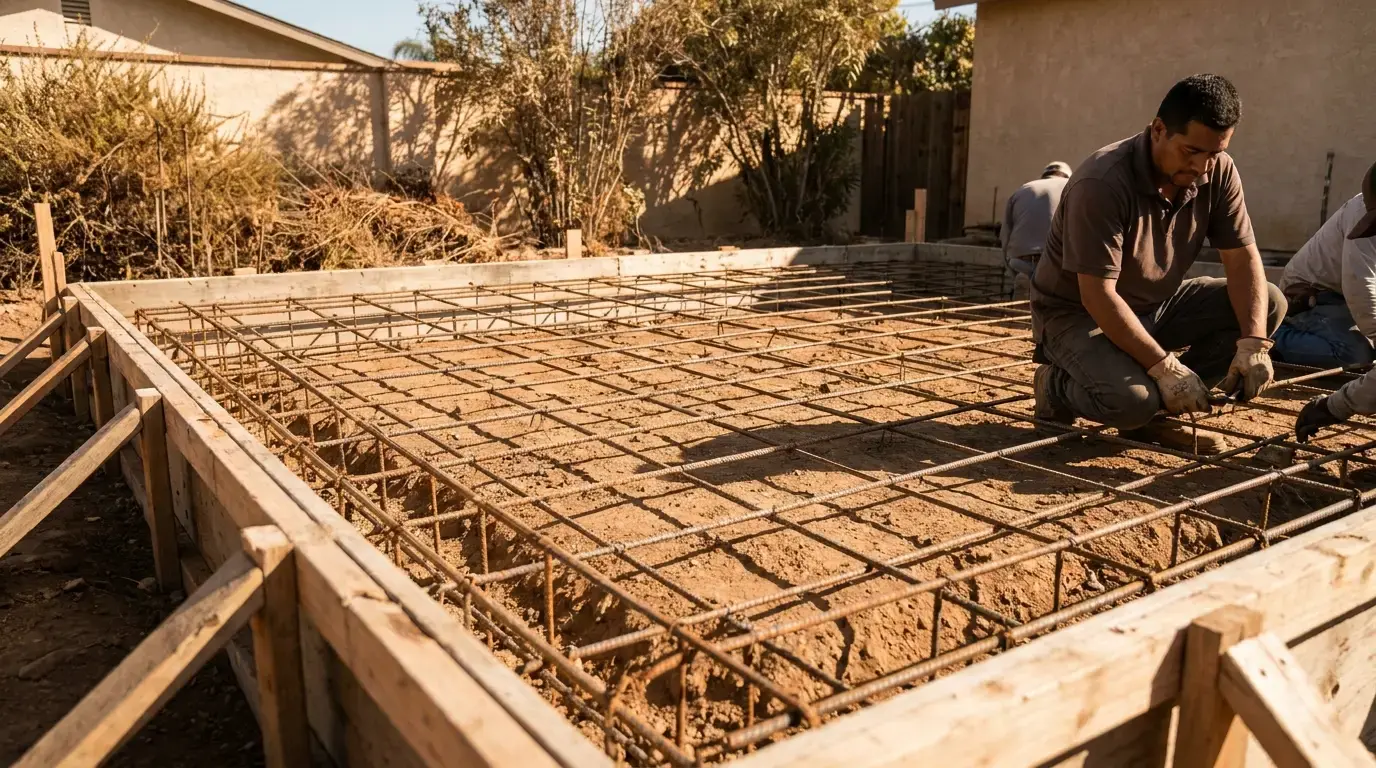
The foundation under your ADU isn’t a detail to sort out later. It’s one of the first decisions that locks in your cost and your timeline. Pick the wrong type for your soil conditions, skip the soils report when you need one, or underestimate what San Diego’s clay and slopes demand, and you’ll pay to fix it twice.
Here’s what you need to know before your project gets off the ground.
Why ADUs are everywhere right now
San Diego added thousands of ADUs over the past few years. State law removed most local barriers, so backyard cottages, garage conversions, and detached guest houses are now common across neighborhoods from Normal Heights to Santee to Chula Vista.
The appeal is real: rental income, multigenerational living, or added home value. But an ADU is still a permitted structure. It has to meet building code, and the building department will check every layer, starting with the foundation.
The two foundation types you’ll choose between
Almost every ADU in San Diego ends up on one of two foundation systems. Your soil, lot grade, and structure size drive which one makes sense.
| Foundation type | How it works | Best fit | Watch out for |
|---|---|---|---|
| Slab-on-grade | Concrete poured directly on prepared, compacted soil | Flat lots, stable soils, detached structures | Expansive clay, poor drainage, hillside sites |
| Raised (pier-and-beam or perimeter stem wall) | Structure sits above grade on piers or a perimeter wall with a crawlspace | Sloped lots, areas with expansive soil, garage conversions where a slab already exists | Higher material cost, more subfloor work |
Slabs are faster and generally less expensive when the soil cooperates. Raised systems give you more flexibility on difficult sites and make future access to plumbing and electrical easier. Neither is universally better. What matters is matching the system to the ground beneath it.
When San Diego requires a geotechnical (soils) report
Not every ADU project triggers a mandatory soils report, but a lot of San Diego lots do. The building department or a plan checker will typically require one when:
- Your lot is on or near a hillside or canyon rim
- There’s known or suspected expansive clay (common in inland San Diego valleys)
- The site has fill soil, especially if it wasn’t engineered fill
- You’re in a liquefaction or landslide zone
- The structure exceeds a certain size or load
San Diego’s geology is genuinely varied. Coastal mesa soils behave differently than East County decomposed granite, which behaves differently than the expansive clay found across much of the inland valleys. You can read more about how clay affects foundations specifically in our post on expansive clay soils in San Diego.
A soils report, prepared by a licensed geotechnical engineer, tells your structural engineer what the soil can carry, how deep footings need to go, and whether any ground treatment is needed before you pour. It’s not cheap, typically a few thousand dollars depending on the number of borings required, but skipping it on a site that needs one creates real risk.
Hillside lots: a different level of complexity
San Diego has a lot of hills. If your backyard drops away from the house or you’re on a canyon edge, foundation design gets more involved.
Sloped sites often need:
- Deeper or stepped footings to reach competent soil at consistent bearing depth
- Grade beams tying the foundation together across the slope
- Retaining walls or cut-and-fill work to create a level pad
- Special attention to drainage so water doesn’t undermine the foundation after the fact
Our soil stabilization services address situations where the ground itself needs treatment before a foundation can be placed. On hillside lots, this isn’t rare.
What garage conversion ADUs need
Converting an attached or detached garage to living space is one of the most common ADU paths. It’s often faster because the shell already exists. But the foundation still gets scrutinized.
Garage slabs are typically four inches thick and may not have continuous perimeter footings or rebar layouts that meet residential occupancy requirements. The plan checker will look at this. Common outcomes:
- Adding a perimeter stem wall or thickened edge beam around the existing slab
- Pouring a new slab if the existing one is cracked, settled, or undersized
- Adding anchor bolts or hardware to connect the structure to the foundation per current seismic requirements
If the garage has any settlement, cracks, or slab heave, those get flagged before the conversion permit moves forward. A foundation inspection at the start of a garage conversion project tells you what you’re working with before the architect draws plans around assumptions. It also helps you avoid surprises mid-permit.
Permitting basics
ADU foundations go through the same building department process as any other residential foundation. You’ll need engineered plans, meaning a licensed structural engineer stamps the foundation design. The city or county will review those plans, issue a permit, and then inspect the work at key stages: before the pour, after forms and rebar are set, and sometimes after backfill.
Do not skip inspections or pour before the inspector signs off. That’s a code violation that can require breaking out concrete to prove what’s underneath.
If your lot is in unincorporated San Diego County rather than a city, the County Department of Planning and Development Services handles permits. Process is similar, but timelines and specific requirements can differ from city jurisdictions.
We work alongside your ADU designer and structural engineer, not independently of them. The foundation work follows from their engineered plans. Our job is to execute the work correctly and to flag anything we see in the field that the design needs to account for.
What drives the cost
Foundation cost for an ADU varies widely. A simple slab on a flat, stable lot in a straightforward city jurisdiction costs far less than a raised perimeter foundation on a sloped lot with expansive clay. Common cost drivers:
- Foundation type (slab vs raised)
- Site access (tight backyard, narrow gate, no truck access)
- Soil conditions and whether stabilization or import fill is needed
- Depth required to reach bearing soil
- Soils report and engineering fees (these are separate from construction)
- Permitting fees and plan check timing
- Whether an existing slab needs demo and removal
You can get a rough sense of foundation cost ranges from our foundation repair cost guide for San Diego, though ADU new construction and repair work have some different variables. General ballpark for a new ADU foundation runs from around $8,000 on the low end for a small, simple slab to $30,000 or more for complex raised systems on difficult sites.
Settlement risk and how it gets designed out
One of the main jobs of a properly engineered ADU foundation is preventing differential settlement, where one part of the structure sinks more than another. That’s what causes doors to stick, cracks to appear in drywall, and floors to go uneven.
The design tools for preventing it: footings at the right depth, proper bearing area, compacted and tested subgrade, and sometimes ground improvement work if the native soil isn’t adequate. On expansive clay sites, the engineer may also specify a post-tensioned slab or a raised system specifically to reduce the effect of soil movement on the structure above.
Our foundation inspection checklist post covers what inspectors look for on residential foundations, which overlaps significantly with what gets reviewed on ADU foundation work.
If you’re also concerned about an existing home foundation on the same property, our house leveling services and foundation repair services address settlement that’s already happened.
Starting your ADU project on solid ground
If you’re planning an ADU and want to understand what the foundation will require before the design gets too far along, we offer free site assessments. We’ll walk the lot with you, look at existing conditions, talk through what the soil and grade are likely to demand, and give you honest input on what to budget before you’re committed.
Call us at (858) 925-5546 to set one up. It’s a straightforward conversation, and it saves you from finding out the hard way that the foundation was the part you should have planned for first.